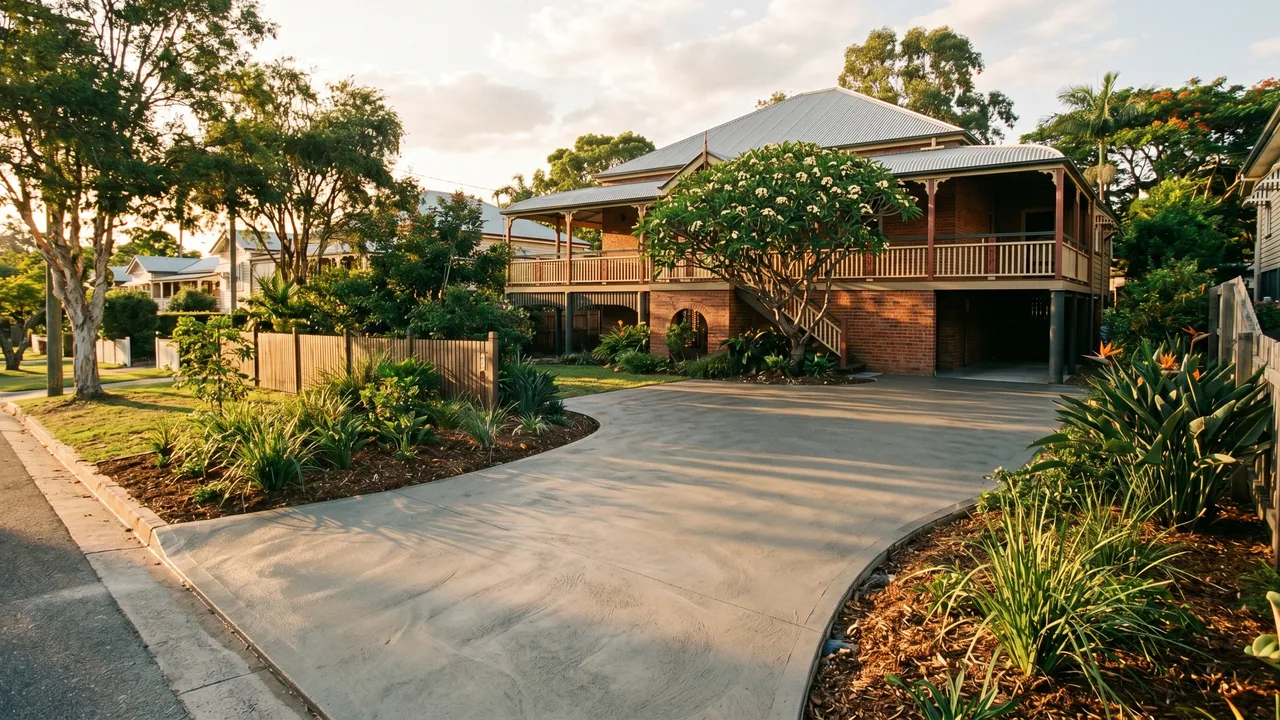
Concreting
Concrete Driveway Installation.
New Concrete Driveways for Chelmer and the Western Suburbs
A new concrete driveway is one of the more straightforward upgrades you can make to a Brisbane home, but it does involve more physical work than most people expect. Understanding what actually happens on the day, and what the job costs in this part of Brisbane, helps you ask the right questions before anyone picks up a shovel.
What the Work Actually Involves
A concrete driveway installation starts well before any concrete is poured. The existing surface, whether that is old cracked concrete, pavers, or compacted gravel, gets broken up and carted away. The base is then excavated to a consistent depth, typically 100 mm below finished slab height for a residential driveway, and compacted with a plate compactor.
Steel reinforcement (usually F72 or F82 mesh, sometimes bar for heavier-load sections near the garage entry) is set on plastic chairs to hold it at the right height within the pour. Formwork boards define the slab edges and control the finished levels so water drains away from the house rather than pooling at the kerb or the garage door.
Then the concrete arrives, almost always by ready-mix truck in this area because the volumes involved make site-mixed concrete impractical. The crew places and screeds the mix, then finishes the surface. For a plain driveway that means a broom finish, which gives grip in wet weather. If you are after exposed aggregate, that is a separate process (see our Exposed Aggregate Finish service).
Expansion joints are cut or formed at regular intervals to give the slab somewhere to move as temperatures change. In Brisbane's western suburbs the heat is real in summer, and a slab without proper joints can crack through rather than at a controlled joint line.
Curing takes around four weeks before you should park a loaded trailer on it, though normal car use is typically fine after about seven days.
When You Actually Need This Service
The clearest signs are visible: wide cracks that have lifted or separated, sections that rock underfoot, or a surface so spalled that water sits in puddles rather than sheeting off. Tree roots are a common culprit in Chelmer, Sherwood, and Graceville, where large mature trees are close to driveways.
Sometimes the driveway is structurally sound but badly stained or worn. In that case, resurfacing may be worth considering before committing to a full replacement. If the existing slab is heaving or the base has been compromised by water or roots, resurfacing is only a short-term fix and full replacement makes more financial sense.
There is no fixed replacement cycle for concrete. A well-installed driveway on a stable base can last 30 years or more in Brisbane conditions. Poor installation, inadequate reinforcement, or aggressive tree roots can see problems within a decade.
What It Typically Costs in Brisbane's Western Suburbs
For a standard single-width residential driveway, expect to pay roughly $3,000 to $6,500 installed. A double-width or longer run to a rear garage can push into the $7,000 to $12,000 range. These figures are typical for Chelmer, Indooroopilly, Taringa, and nearby suburbs, but they are starting points.
What moves the price:
- Slab dimensions. Length and width directly drive concrete volume and labour time.
- Access. A truck that cannot reach the pour site means concrete pumping, which adds cost (typically $600 to $1,200 depending on distance).
- Demolition and disposal. Breaking up an existing concrete driveway and removing it is a line item, usually $500 to $1,500 for a standard residential job.
- Ground conditions. Soft or uneven sub-base means more excavation and fill work.
- Finish type. Plain broom finish is the base cost. Exposed aggregate or a stencilled pattern adds to that.
- Slope. Steep blocks, common in Taringa and parts of St Lucia, require more formwork work and care with drainage, both of which take more time.
What Is and Is Not Typically Included in a Quote
A standard quote should include excavation, base preparation, reinforcement mesh, concrete supply, pouring, finishing, and formwork removal. Ask specifically about:
- Disposal of demolished concrete (sometimes quoted separately)
- Council permit fees, if required for your property
- Concrete pump hire, if truck access is restricted
- Edge treatments or garden borders
Always get a written quote and check what triggers a variation charge.
Is This the Right Service for Your Property?
Concrete suits most Brisbane western suburbs driveways well. It handles vehicle load without ongoing maintenance, unlike loose gravel, and holds up to Brisbane summers better than asphalt, which can soften in extreme heat. If you have large trees close to the driveway line, it is worth discussing root management with the concretor before pouring, not after.
If your existing driveway has only surface cracking or staining with a sound base, our Concrete Repair and Resurfacing service may be the more cost-effective option.
A Straightforward Note on Safety and Licensing
Concrete work in Queensland does not require a builder's licence for most residential driveway jobs, but the person doing the work should carry public liability insurance. Before any work starts, ask to see proof of that insurance. It protects you if something goes wrong on your property during the job.
We connect homeowners with local concreting providers who carry appropriate cover. If you would like to talk through your driveway and get a quote organised, get in touch and we will put you in contact with someone who works in your suburb.
Quick answers
Frequently asked.
How long does a concrete driveway installation take in Brisbane?
Do I need a council permit to replace my driveway in Brisbane?
Can concrete driveways handle tree roots in older Chelmer and Sherwood suburbs?
What is the difference between a broom finish and exposed aggregate for a driveway?
Is concrete or pavers better for a Brisbane western suburbs driveway?
What should I check before a concretor starts work on my property?
Ready to book
Quickest is by phone.
Up-front pricing on the call. Booked in one go. No site visit needed.