Concreting
Concrete Repair and Resurfacing.
What Concrete Repair and Resurfacing Actually Involves
Concrete doesn't last forever, especially on Brisbane's older blocks where slabs have been baking through decades of Queensland summers. Repair and resurfacing is the work done to extend the life of concrete that's still structurally sound but showing visible deterioration.
The physical work varies by problem. For cracks, a tradie will typically cut the crack wider with an angle grinder or crack chaser (a specialised diamond-blade saw), clean out debris with compressed air, then fill with a flexible polyurethane sealant or epoxy resin, depending on crack width and movement. For spalling (where the surface layer flakes or pops off, often exposing aggregate beneath), the loose material gets chipped back, the area is primed, and a repair mortar or resurfacing compound is trowelled on. For larger-scale resurfacing of a full driveway or path, a skim coat of polymer-modified overlay is applied across the whole surface to unify appearance and seal minor defects.
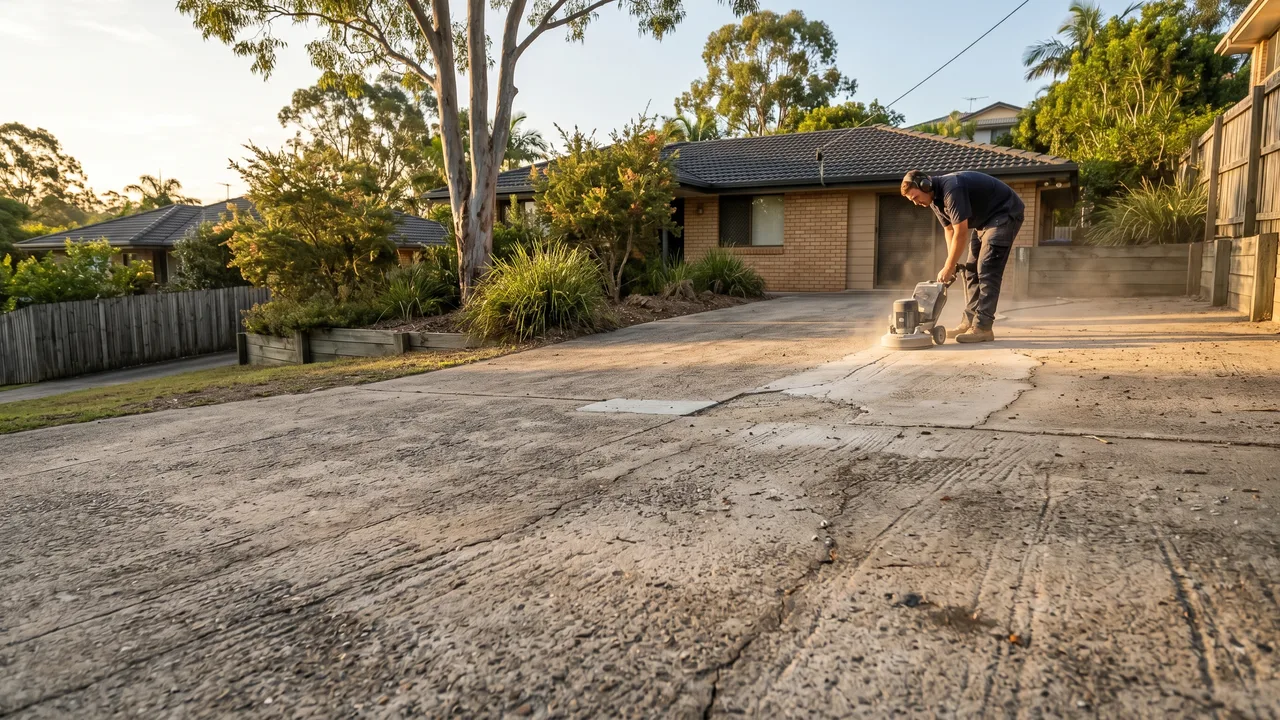
Equipment on a typical job includes angle grinders, a pressure washer for prep, mixing paddles, trowels, and possibly a grinding machine for surface profiling. The bond between old and new concrete is the critical point. If the surface isn't prepared properly, new material lifts within a season.
Signs a Chelmer or Western Suburbs Home Needs This Work
Chelmer and surrounding suburbs like Graceville, Corinda, and Sherwood have a lot of homes built from the 1950s through to the 1980s. Original concrete work from that era is typically reaching the end of its comfortable life, and Brisbane's climate accelerates things.
Watch for these signs:
- Cracks wider than 2-3mm, or cracks that are growing noticeably over time
- Spalling or flaking, where the surface is lifting in chunks or patches
- Pitting and surface roughness that wasn't there when the slab was poured
- Discolouration or staining that doesn't respond to cleaning
- Trip edges where sections have lifted or settled unevenly
- Soft or hollow spots that sound different when tapped
Timing matters a little. Late dry season (August to October) is typically a good window for repair work in Brisbane, as the low humidity supports proper curing. Avoid planning resurfacing just before the wet season if you can help it.
What It Costs in Brisbane
For concrete repair and resurfacing, most residential jobs in this area fall somewhere between $500 and $6,000, depending on scope. That's a wide range, so here's what moves the price:
- Crack repairs only on a path or small section: typically $500 to $1,200
- Spalling repairs to a driveway with moderate damage: commonly $1,000 to $2,500
- Full resurfacing of a standard single-car driveway (around 30-40sqm): often $1,500 to $3,500
- Full double-driveway resurfacing with decorative overlay: can reach $4,500 to $6,000+
These are indicative figures based on typical Brisbane jobs. Your actual quote depends on access, how much prep work is needed, and material choice.
What's Usually Included in a Quote
A properly scoped quote should include surface cleaning and preparation, crack or spalling repairs as specified, the resurfacing material and labour, and basic sealing of the finished surface.
What Often Costs Extra
Watch for these items that may not be in a base quote:
- Removal of heavy staining (oil, paint, chemical) before resurfacing
- Access issues, such as tight side gates, equipment that can't get close to the slab, or restricted street parking for a concrete truck or trailer
- Decorative finishes beyond a standard grey overlay
- Any underlying drainage or structural issues found during prep
Get a written quote that lists inclusions clearly. Vague quotes are where surprises happen.
Is Repair and Resurfacing the Right Call for Your Slab?
This is the honest question. Resurfacing works well when the concrete underneath is structurally sound. If the slab has significant base movement, deep cracking through the full thickness, or drainage problems causing ongoing heave, resurfacing is a short-term fix at best. In those cases, replacement is more cost-effective over a five-year horizon.
A rough rule of thumb: if more than 30-40% of the surface has damage, or if you're seeing cracks that open and close with the seasons, get an honest opinion on whether you're patching or postponing.
If the slab is solid and the damage is mainly surface-level, resurfacing is genuinely good value and can add years to the concrete's life.
A Note on Qualifications and Insurance
Concrete repair and resurfacing doesn't require a builder's licence in Queensland for most residential work, but it does involve preparation chemicals, grinding equipment, and materials that bond permanently to your property. You want someone with demonstrated experience doing this specific type of work, not just general labouring.
Ask any provider you're considering whether they carry public liability insurance. $10 million is a typical minimum for residential concreting work. That protects you if something goes wrong on your property.
We connect Chelmer-area homeowners with local concreters who work in this cluster regularly. If you'd like a quote on a driveway, path, or slab that's showing its age, give us a call and describe what you're seeing. We'll point you to someone who can give you a straight answer.
Quick answers
Frequently asked.
Can you resurface concrete that has a lot of cracks?
How long does resurfaced concrete last?
Is concrete resurfacing cheaper than replacement?
What causes concrete to spall or flake in Brisbane?
Do I need council approval for concrete repair or resurfacing in Brisbane?
How do I know if my concrete needs repair or full replacement?
Ready to book
Quickest is by phone.
Up-front pricing on the call. Booked in one go. No site visit needed.