Concreting
Concrete Pathway Installation.
Concrete Pathway Installation in Chelmer
A concrete path sounds simple enough. In practice, there's more to it than pouring a strip of grey and calling it done. Done properly, a path handles foot traffic, tree roots, drainage, and the odd wheelbarrow without cracking apart inside five years. Done poorly, it lifts, cracks, or pools water against your house.
Here's what's actually involved, what it costs in Brisbane's western suburbs, and how to tell if a new path is what your property needs.
What the Work Actually Involves
A concrete pathway job typically covers three types of paths on residential blocks:
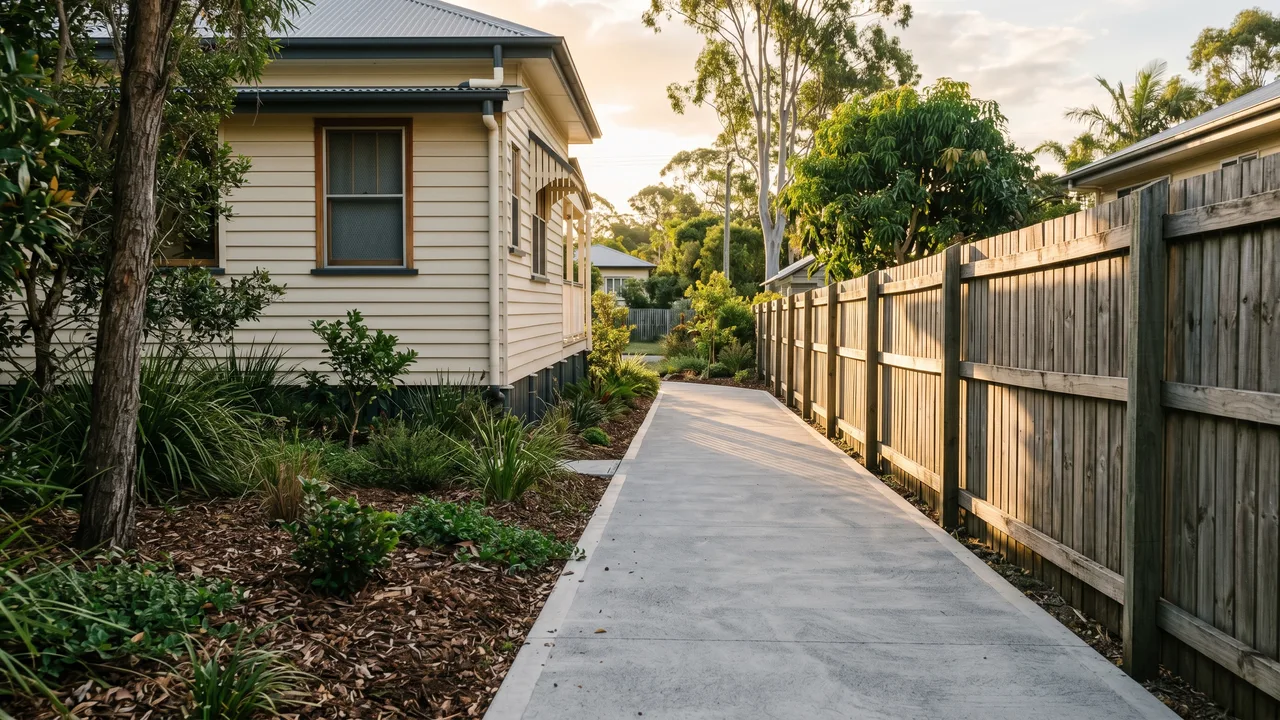
- Side access paths running along the house boundary, often 900mm to 1.2m wide to meet council access requirements
- Front entry paths connecting the street, driveway, or gate to your front door
- Garden walkways through yard areas, sometimes with gentler curves or stepping-stone-style pours
The physical process starts with marking out the path line and excavating to a depth that suits the soil and expected load. In Chelmer and surrounding suburbs, you'll often find old fill, tree roots (jacaranda and fig roots are common here), or clay subsoils that need extra attention before anything is poured.
Formwork timber is set along the edges to hold the concrete in shape. For most residential paths, 100mm of concrete is standard; heavier-use side access paths or those that carry a ride-on mower may go to 125mm. Steel reinforcement mesh is typically laid before the pour to reduce cracking over time.
Concrete is ordered to the job spec, delivered by truck or mixed on site for smaller runs, then poured, screeded flat, and finished. Edge profiles are formed before the concrete sets. Expansion joints are cut or formed at intervals to control where cracking occurs if the slab moves, which is honest industry practice, not a weakness.
Curing takes around 24 to 48 hours before foot traffic, and the concrete continues to harden over the following weeks.
When Do You Actually Need One?
A few signs it's worth looking at a new path:
- The existing path is lifting at the edges, cracking across the surface, or has a lip that's become a trip hazard
- You have no sealed path along the side of the house and wet weather turns the gap into a mud run
- You're selling, renting, or renovating and a broken or missing path is affecting the presentation and function of the property
- You've recently had a new driveway or slab poured and the connecting path no longer lines up properly
There's no particular season for this work in Brisbane, but avoiding the peak of summer (pouring concrete in 35°C heat adds complexity) and planning around the wet season makes scheduling easier. Most jobs in the inner west and southern suburbs can be completed within a day or two once booked.
What Does It Cost in Brisbane?
Concrete pathway installation in Brisbane's western suburbs typically runs between $70 and $120 per square metre for a straightforward pour with a broom or steel-trowel finish. A standard 15 square metre side access path might land somewhere between $1,200 and $1,800 depending on conditions.
What pushes the price up:
- Poor access for the concrete truck (narrow gates, long carry distances)
- Extensive root or rubble removal before pouring
- Significant falls or cross-falls needed for drainage
- Decorative finishes such as exposed aggregate or stencilled colour (these are priced separately)
- Retaining the existing garden beds or edging along the path route
What's usually included in a quoted price: excavation to standard depth, formwork, mesh reinforcement, concrete supply and pour, finishing, and basic cleanup.
What's typically quoted as an extra: demolition and removal of an old concrete or brick path, tree root grinding, any retaining or garden edging work adjacent to the path, and permit costs if applicable. Always confirm these items before signing anything.
Is This the Right Service for Your Property?
If your path is cracked, sunken, or missing entirely, a new concrete pour is usually the right call. If the existing concrete is sound but looks tired or stained, resurfacing may be a better fit (that's a separate service). If the damage is isolated to one or two sections, repair is worth exploring before committing to a full replacement.
A Chelmer home with an older Queenslander-style house often has narrow side access and established garden beds close to the building line. That's manageable, but it's worth being upfront with your concreter about access constraints so the quote reflects the actual job.
A Note on Safety and Qualifications
Concrete pathway work in Queensland doesn't require a contractor's licence for paths and slabs that aren't connected to a building structure, but using someone with a current public liability policy still matters. If anything goes wrong with a poorly set path (trip, drainage issue, damage to adjacent property), you want to know there's insurance behind the job.
When you submit an enquiry through this service, we pass your details to local concreting providers who carry appropriate insurance for residential work. We're a referral service, not the contractor ourselves, and we're upfront about that.
If you'd like an accurate quote for your specific path layout, get in touch with the dimensions and a photo of the site. That's the fastest way to get a number that actually reflects your job.
Quick answers
Frequently asked.
How thick does a residential concrete path need to be in Brisbane?
Do I need council approval for a new concrete path in Chelmer?
How long does a concrete pathway installation take?
What's the difference between a broom finish and a steel-trowel finish for a path?
Can tree roots damage a new concrete path?
What's typically not included in a concrete path quote?
Ready to book
Quickest is by phone.
Up-front pricing on the call. Booked in one go. No site visit needed.