Concreting guide
Mesh, rebar, or fibres: what reinforcement does your slab actually need?
Mesh, Rebar, or Fibres: What Reinforcement Does Your Slab Actually Need?
The honest answer is: it depends on what the slab carries, how thick it is, and what's underneath it. For a standard 100 mm footpath or patio in a Chelmer backyard, SL72 mesh is usually fine. For a garage slab that'll have a loaded trailer sitting on it, or a driveway on reactive clay soil, you probably want rebar, thicker concrete, or both. Here's how to think it through.
Why Concrete Needs Reinforcement at All
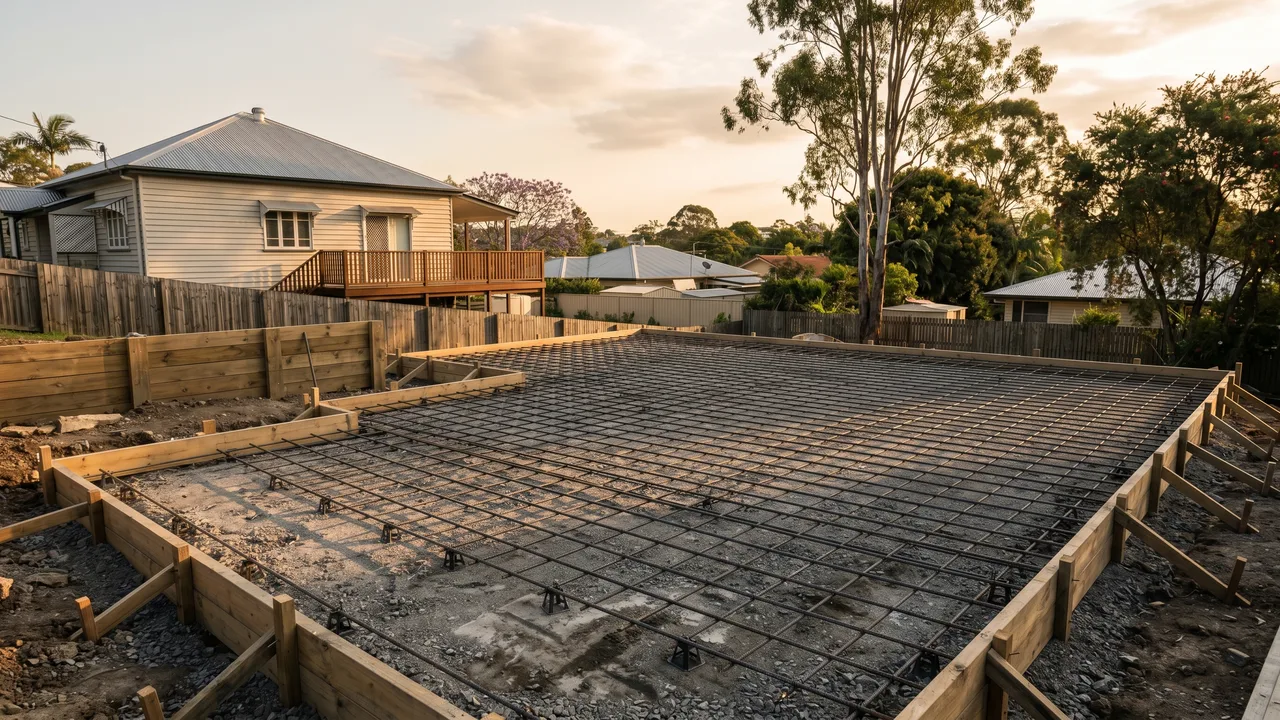
Plain concrete is strong in compression. Press down on it and it holds up well. But pull it apart, bend it, or let the ground move underneath it, and it cracks. Reinforcement (whether steel mesh, deformed bar, or fibres) gives the concrete tensile strength so it can flex slightly without fracturing.
In Brisbane's Inner West, this matters more than people expect. Suburbs like Chelmer, Corinda, Graceville, and Yeronga sit on clay-heavy soils that shrink in the dry and swell in the wet. That seasonal movement puts real stress on any slab, even one that looks well-supported at the time of pour. A slab with inadequate reinforcement in these conditions won't necessarily crack the day it's poured. It might look perfect for three years, then crack after a dry summer followed by a wet La Niña season.
Steel Mesh: The Workhorse for Most Residential Slabs
Steel fabric mesh (commonly called "SL mesh" in Australia) comes in standard sheet sizes, with SL72 and SL82 being the grades most commonly used in residential work. The numbers refer to the wire diameter and spacing. SL72 has 7.6 mm wires at 200 mm centres; SL82 has 8.6 mm wires at 200 mm centres and is a step up in strength.
For most domestic jobs in the Inner West, SL72 mesh in a 100 mm slab is the baseline. Patios, alfresco areas, pathways, and pool surrounds typically fall into this category. It's cost-effective, quick to install, and well understood by any experienced concreter.
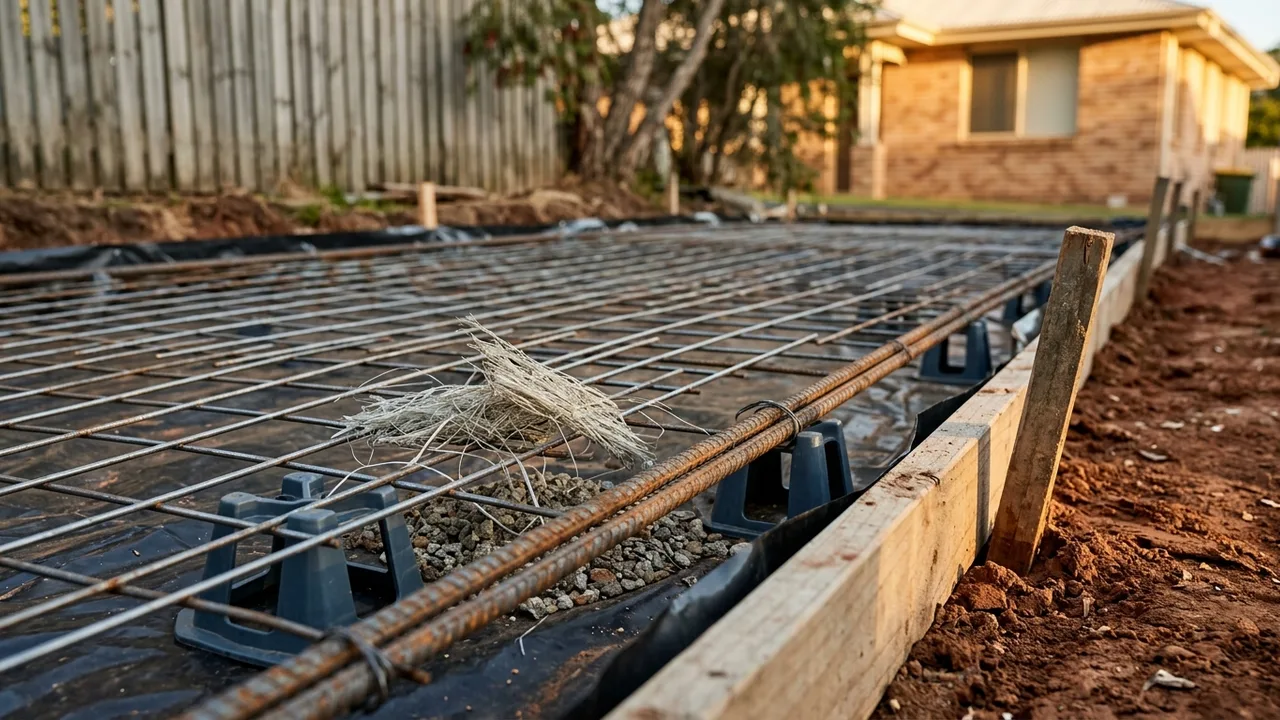
The catch: mesh only works if it's positioned correctly in the slab. It needs to sit in the bottom third of the pour (typically 40-50 mm from the base) so it can actually resist tension. A slab where the mesh has sunk to the bottom or floated to the top is effectively unreinforced. This is one of those things that's easy to check on-site during the pour if you're watching, but invisible once the concrete sets.
When mesh isn't enough: on significant slopes, in heavy-vehicle areas (like a driveway that'll take a concrete truck or a boat trailer), or anywhere the subgrade is poorly compacted or poorly draining.
Rebar: When You Need More Control Over Where the Strength Goes
Deformed steel bar (rebar) gives engineers and concreters more flexibility. Unlike mesh, rebar can be placed at specific depths, lapped at custom lengths, and arranged in patterns that address known stress points, like the edge of a slab, around penetrations (drainage pits, posts), or beneath concentrated loads.
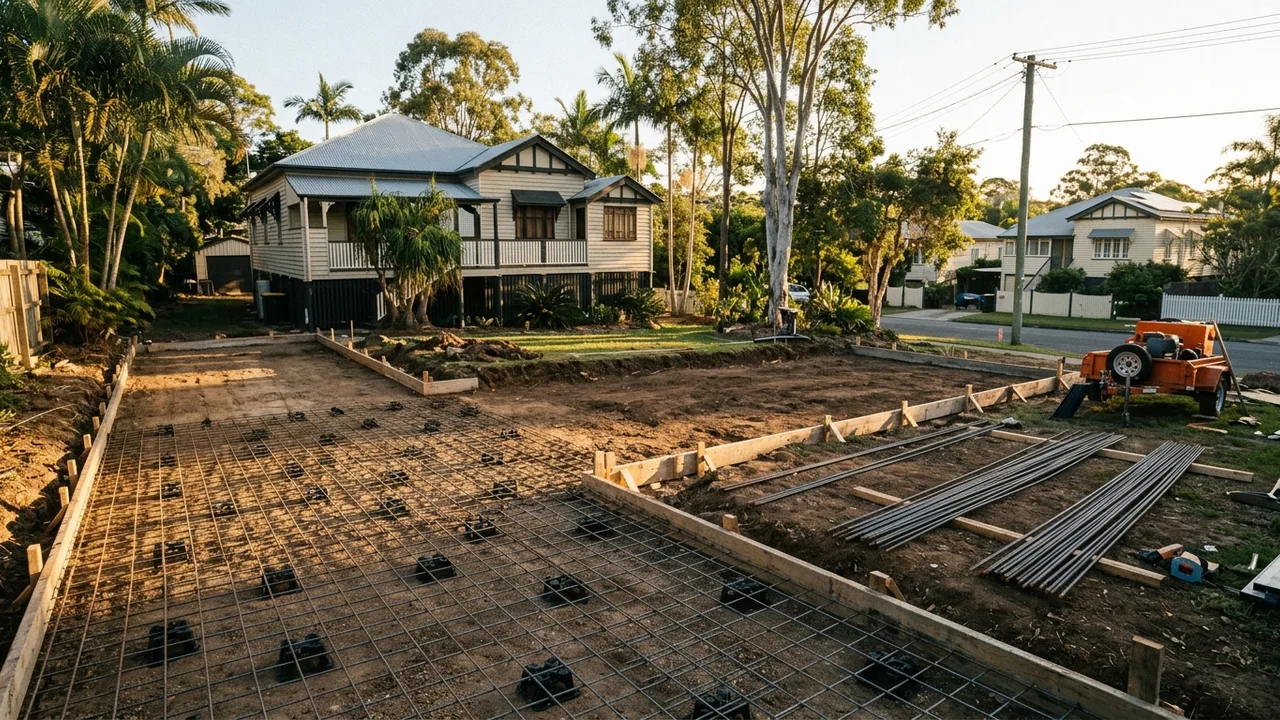
For a garage slab in Indooroopilly or Taringa that'll support a vehicle hoist or a heavy workshop setup, you'd typically see rebar at N12 (12 mm diameter) or N16 in a 125 mm or 150 mm slab. Shed slabs for standard garden sheds might be fine with mesh, but a steel shed that'll be used as a workshop and loaded with equipment is a different animal.
Rebar is also the better choice when soil conditions are problematic. If a site has had fill placed (common on the steeper blocks through Sherwood and Moorooka where cut-and-fill earthworks are routine), or if there's poor drainage, the extra control over reinforcement layout matters.
The trade-off: rebar takes more time to cut, bend, and tie, which adds labour cost. On a simple 6 x 6 m slab, the difference in materials might only be a few hundred dollars, but once you're factoring in labour and the time to position and inspect it, the gap widens. For a complex driveway or a large garage floor, that cost is usually justified.
Synthetic Fibres: A Useful Addition, Not Usually a Replacement
Polypropylene or steel fibres are mixed directly into the concrete batch and distributed throughout the pour. They're good at controlling plastic shrinkage cracking, which is the fine surface cracking that appears in the hours after a pour as concrete dries.
Fibres have a genuine role in the mix, particularly in hot weather pours or when you're working on a large exposed surface that might dry unevenly. Brisbane summers make this relevant. A pour on a January afternoon in Fairfield, with sun on the slab and a westerly drying the surface, benefits from fibres in the mix.
What fibres don't do well is replace the structural role of mesh or rebar. They improve durability and reduce surface cracking, but they don't significantly add to the slab's ability to resist the bending forces from soil movement or heavy loads. Think of them as a supplement, not a substitute.
Some concreters will suggest a fibre-reinforced mix in place of mesh for lighter applications (like a garden path or a small shed base). That can be defensible in the right conditions, but it's worth asking specifically what the reasoning is and whether it meets Australian Standard AS 3600 requirements for your application.
Slab Thickness: The Variable That Changes Everything
Reinforcement choices can't be separated from thickness. A 75 mm slab with SL72 mesh is not remotely equivalent to a 100 mm slab with the same mesh, even though both have "mesh in them." Thickness affects load distribution, cover over the steel (which protects it from corrosion), and how much the slab can flex before cracking.
As a rule of thumb in Brisbane residential work:
- Pathways and garden paths: 75-100 mm, SL72 mesh or fibres.
- Patios and alfresco slabs: 100 mm, SL72 or SL82 mesh.
- Driveways (standard passenger vehicles): 100 mm minimum, SL82 mesh, ideally 125 mm on clay soils.
- Driveways (heavy vehicles, boats, trailers): 125-150 mm, rebar or reinforced mesh.
- Garage and shed slabs: 100 mm with SL82 as a minimum; 125 mm with rebar for anything carrying significant equipment or loads.
These are general starting points. Soil testing, local council requirements, and the actual intended use can all shift these numbers.
What to Ask a Concreter Before Work Starts
Before you sign off on a quote, it's worth getting a few specifics in writing:
- What mesh or rebar specification is included, and what Australian Standard does it meet?
- What is the slab thickness and concrete strength (MPa rating) in the quote?
- How will the reinforcement be held at the correct depth (bar chairs or other supports)?
- Is fibre being added to the mix, and why (or why not)?
- What site preparation is included, particularly for compaction?
A good concreter won't be put out by these questions. The answers tell you whether a quote is for a job done properly or a job done cheaply. In the Inner West where clay soils and sloping blocks are common, cutting corners on reinforcement and subgrade prep is where slabs fail.
If you're comparing quotes that differ significantly in price, reinforcement specification is often where the gap lives. Two quotes for a Chelmer garage slab can look similar on paper but be entirely different in what's actually going in the ground.
The Sensible Way to Approach This
For most standard residential jobs (patios, paths, average driveways), the industry-standard mesh options are genuinely adequate when installed correctly at the right depth in a properly prepared subgrade. You don't need to overcomplicate it.
For anything heavier, anything on reactive clay (and much of Brisbane's Inner West qualifies), or anything where the cost of getting it wrong is high (like a driveway that would need full replacement if it failed), it's worth paying for the right spec upfront rather than repairing cracks in three years.
If you're not sure which category your project falls into, the most practical thing to do is talk to a concreter who works regularly in your suburb. They'll have seen what fails and what holds up in your specific conditions. That local experience is genuinely useful and it's not something a generic guide can fully replace.
If you'd like to connect with a concreter familiar with jobs across Chelmer, Indooroopilly, Sherwood, and the surrounding suburbs, get in touch and we can point you toward someone who can give you a straight answer.
Quick answers