Concreting guide
How long should a concrete driveway or slab last in Brisbane?
A well-poured concrete driveway or slab in Brisbane should last somewhere between 25 and 50 years. That range is wide on purpose — because how long yours actually lasts depends heavily on how it was installed, what the ground beneath it is doing, and how much punishment it takes over the decades.
What the Concrete Itself Can Handle
Concrete is a mix of cement, aggregate (sand and gravel), and water. Once it cures, it reaches a compressive strength measured in megapascals (MPa). Residential driveways in Brisbane are typically poured to 25 MPa or 32 MPa. A properly mixed and cured 32 MPa slab can handle the weight of passenger cars, small trailers, and the occasional skip bin without much complaint.
The mix design matters more than most homeowners realise. Too much water added on site to make the pour easier — a common shortcut on hot days — weakens the finished slab significantly. Concrete also needs time to cure properly. Rushing the process, or letting a fresh slab dry out too fast in summer heat, leads to surface cracking and reduced long-term strength. In Brisbane's subtropical climate, where summer temperatures regularly climb above 30°C, keeping fresh concrete moist during curing is genuinely important, not just a box to tick.
A well-specified, properly cured slab with no shortcuts should give you the upper end of that 25-to-50-year range without major intervention.
How Brisbane's Soil Affects Longevity
This is where things get suburb-specific, and it matters a lot in the Inner West. Much of Chelmer, Graceville, Sherwood, and Corinda sits on expansive clay soils. These soils shrink when dry and swell when wet. A concrete slab sitting on clay that moves seasonally is under constant low-level stress. Over years, that stress causes cracking and, in worse cases, sections of the slab lifting or subsiding unevenly.
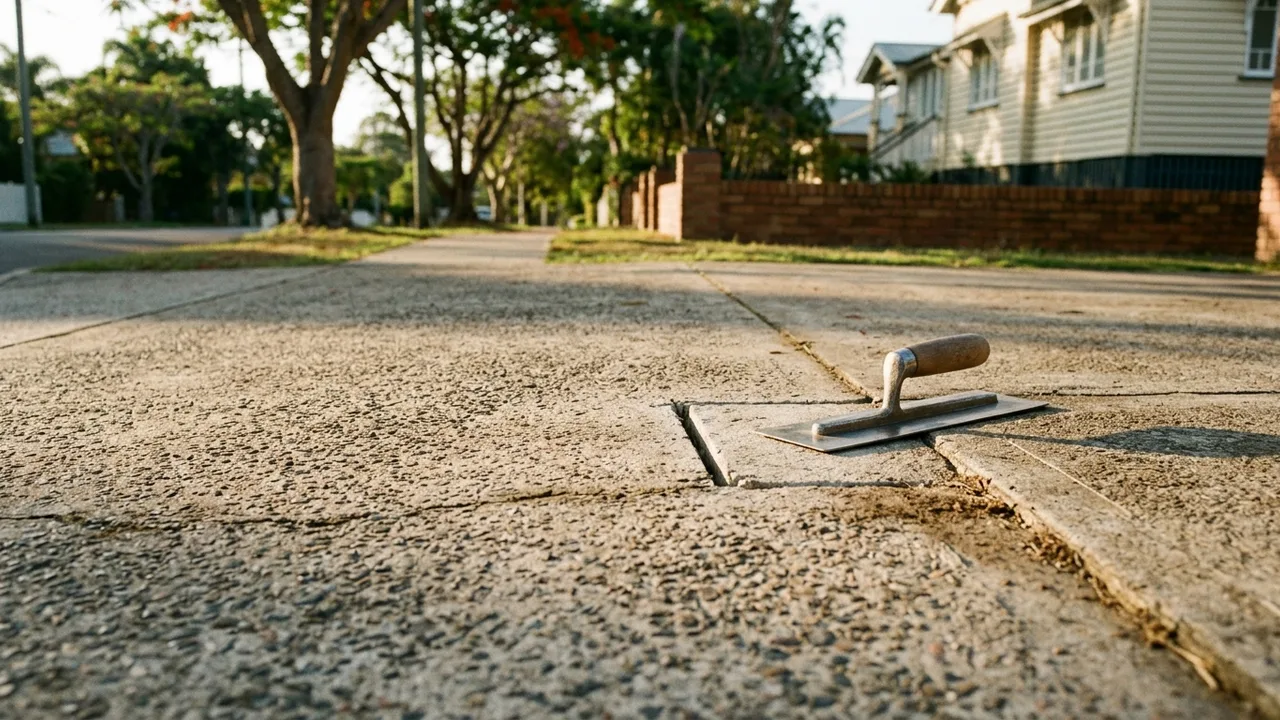
Yeronga, Fairfield, and parts of Moorooka have pockets of fill and sloped terrain that introduce their own complications. Fill that wasn't compacted properly at the time of previous earthworks can settle slowly for years after a slab is poured on top of it.
The practical takeaway: sub-base preparation is not the glamorous part of a concreting job, but it's where long-term performance is won or lost. A 100mm-thick slab on a poorly prepared base will crack faster than an 80mm slab on a correctly compacted and stable base. Good operators compact the sub-base, add crushed rock where needed, and don't skip the prep to shave cost off the quote.
Reinforcement: The Quiet Difference-Maker
Plain, unreinforced concrete cracks. That's not a defect — it's just what concrete does as it expands and contracts. What matters is whether those cracks stay small and stable, or whether they open up and allow water infiltration that accelerates deterioration.
Steel reinforcement (mesh or bar) holds cracks together when they form and distributes loads across the slab rather than concentrating stress at one point. For a driveway in the Inner West suburbs, expect a competent contractor to use F72 or F82 steel mesh as a minimum, installed at the correct height within the slab, not just resting on the ground.
Control joints — the straight lines deliberately cut or formed into a slab — are equally important. They give the concrete a preferred place to crack, typically at a depth of about one-quarter of the slab thickness. A slab without adequate control joints often ends up with random, irregular cracking through the middle of a panel rather than at planned, manageable locations.
Reinforcement doesn't make a slab indestructible. A heavily loaded vehicle repeatedly parking in one spot will stress any residential slab over time. But properly reinforced concrete with good joint spacing will stay functional and structurally sound for decades rather than starting to fail visibly within five to ten years.
What Causes Premature Failure
Most concrete that fails early does so for one of a handful of reasons.
- Poor mix or watered-down concrete on site. Strength is compromised before the slab is even finished.
- Inadequate sub-base compaction. Voids beneath the slab allow it to flex, which concrete cannot do without cracking.
- Insufficient thickness. A 75mm driveway slab might be adequate for a small car on flat, stable ground. It's not adequate for a dual-cab ute on reactive clay.
- No or poorly placed reinforcement. Cracks form and open up with nothing to hold them together.
- Tree roots. This one catches people out in the Inner West, where mature Poinciana, fig, and jacaranda trees are common. A root system pushing up beneath a slab can cause dramatic lifting within ten to fifteen years. It's worth mapping large trees before deciding on a slab location, or installing root barriers where the risk is obvious.
- Water drainage problems. Concrete that sits with water pooling against it — particularly at the edge or at the join with a garage wall — deteriorates faster. Spalling (where the surface flakes and crumbles) is a common result of water penetrating and then drying repeatedly.
Some of these issues are visible early and repairable. Surface spalling, for instance, can often be addressed with resurfacing rather than full replacement, which is a meaningful cost difference — typically $30 to $60 per square metre for resurfacing versus $100 to $160 per square metre for a complete replacement pour, depending on access and specification.
The Maintenance Question
Concrete is often marketed as maintenance-free. That's mostly true compared to timber or pavers, but "mostly" is doing some work in that sentence.
A concrete sealer applied every five to ten years significantly slows surface wear and reduces water penetration. In a bayside suburb, sealers also help against salt-air exposure, though for inland suburbs like Chelmer or Indooroopilly, the priority is more about UV degradation and oil staining from vehicles.
Cleaning matters more than people think. Oil from vehicles left to soak in can penetrate unsealed concrete and cause surface breakdown over time. It also makes the surface slippery when wet, which is a practical safety issue rather than just an aesthetic one.
Crack management is worth taking seriously early. A hairline crack that stays hairline is rarely structural. A crack that's opening up, has vertical displacement (one side higher than the other), or is wider than about 3mm warrants a proper look. Left alone, a crack that admits water in winter and dries out in summer will widen steadily. A crack repair compound or epoxy injection, done early, is inexpensive. Replacing a slab is not.
Making a Decision That Lasts
If you're weighing up a new driveway or slab for a home in Chelmer, Graceville, Sherwood, or the surrounding suburbs, the question isn't just "how long will it last" but "what will make it last longer."
A few specific things are worth asking about before you commit to a quote:
- What MPa is the mix, and who is supplying it? (Batched plant-mixed concrete is more consistent than site-mixed.)
- What is the planned slab thickness, and what reinforcement is specified?
- How will the sub-base be prepared, and will crushed rock be added?
- Where will control joints be placed, and how deep?
- Is a sealer included or recommended, and what type?
These questions aren't adversarial — any competent contractor will have clear answers ready. Vague responses or pushback on the detail is useful information in itself.
The difference between a 25-year slab and a 40-year slab often comes down to decisions made in the first week of the job. Spending a little more time on specification and choosing a contractor who's done work you can actually go and look at in your area is worth more than saving a few hundred dollars on the quote.
If you're at the stage of comparing options for a new or replacement slab around Chelmer or the Inner West suburbs, a conversation with a local operator who works in these specific soil conditions is a reasonable starting point. It costs nothing to ask, and the right advice early saves real money later.
Quick answers