Concreting guide
Exposed aggregate or plain concrete: which suits a Brisbane western suburbs driveway?
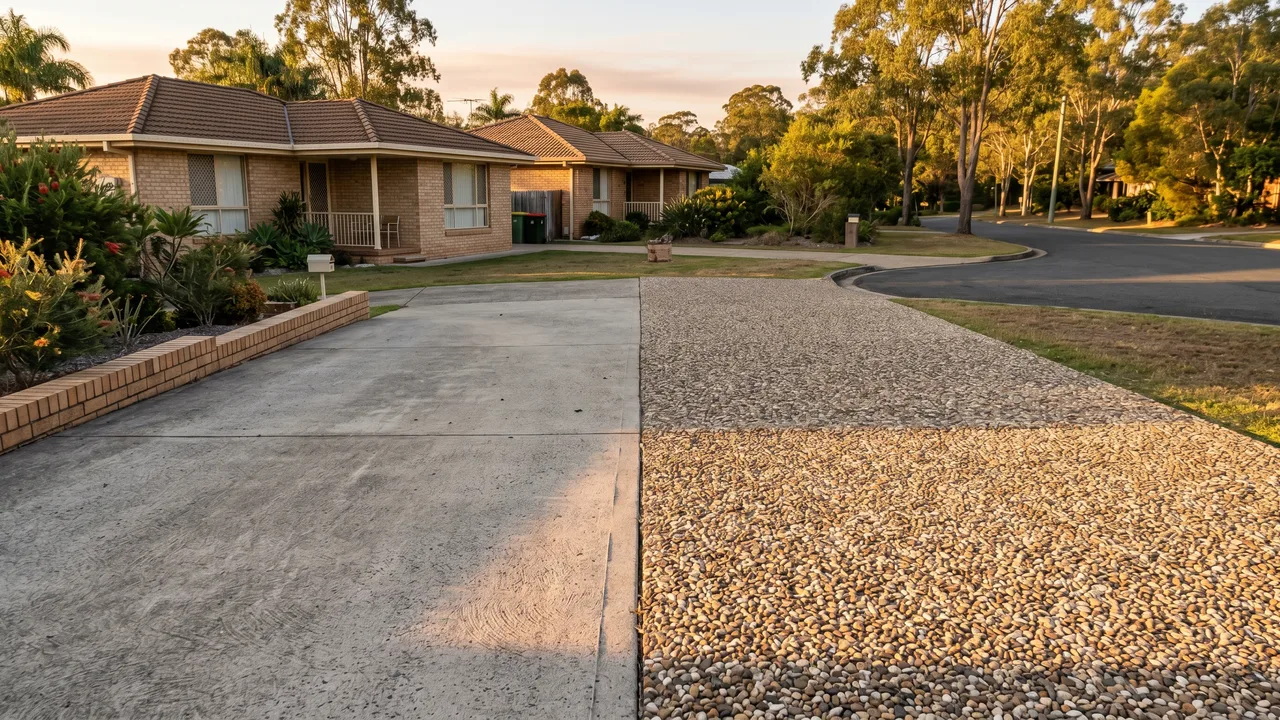
Both finishes can work well on a Brisbane western suburbs driveway. The honest answer is that exposed aggregate suits most homes in this area better, but plain concrete remains a legitimate, cost-effective choice depending on your budget, your house style, and how much maintenance you are willing to do over time.
What the two finishes actually are
Plain concrete is exactly what it sounds like: a poured slab with a smooth or broom-finished surface, left as-is once cured. The broom finish (a light drag of a stiff brush across the wet surface) is the standard choice for driveways because it adds grip without adding cost.
Exposed aggregate is also a poured concrete slab, but during finishing, the top layer of cement paste is washed away before it fully sets. That reveals the stones (the aggregate) embedded in the mix. You end up with a pebbly, textured surface that looks quite different from plain concrete and behaves differently too.
Both finishes use the same reinforced concrete base. The structural performance, the thickness, the mesh or bar reinforcement - none of that changes. What you are choosing is surface character, not structural type.
How Brisbane's western suburbs climate affects your choice
The Inner West corridor from Indooroopilly through Chelmer, Graceville, Sherwood, and down to Yeronga sits a comfortable distance from Moreton Bay, so salt-air corrosion is not a major concern here the way it is for driveways in Wynnum or Redcliffe. That levels the playing field somewhat.
What does matter in this part of Brisbane is heat and organic debris.
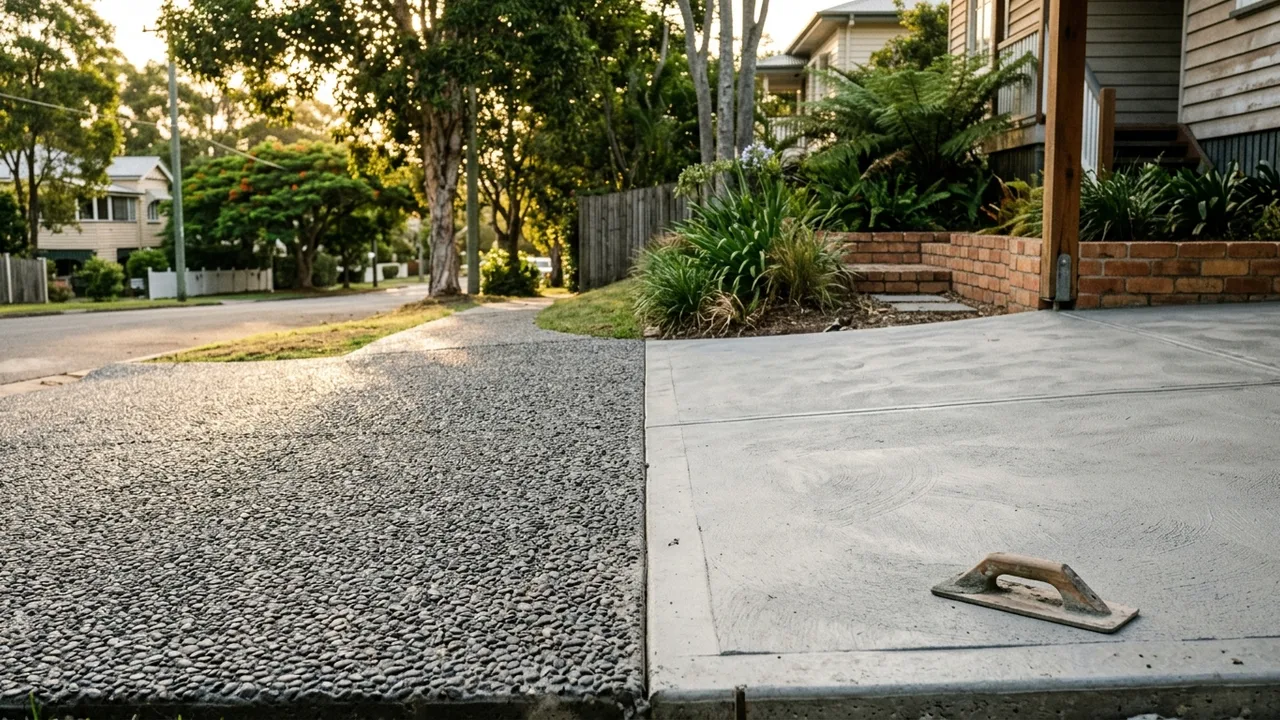
Heat. Western-facing driveways cop the afternoon sun hard. A plain concrete surface, especially a light grey broom finish, reflects more heat than a dark aggregate blend. If you are parking on the driveway and walking across it barefoot, a plain surface runs cooler underfoot in summer. Exposed aggregate in a dark river pebble blend can hold heat longer, though lighter aggregate mixes largely avoid this.
Organic debris. The western suburbs are full of mature trees. Jacaranda in November, poinciana, large fig trees along older streets in Chelmer and Sherwood, and plenty of liquidambar leaves in autumn around Graceville and Corinda. Leaf debris, seed pods, and staining from organic material settle into the textured surface of exposed aggregate and can be harder to clear with a standard garden hose. A broom-finished plain concrete surface is genuinely easier to keep clean with a quick sweep or rinse.
Queenslander blocks. Many homes in this cluster sit on older subdivisions with mature gardens and limited driveway fall. Getting drainage right matters more than finish type, but it is worth noting that exposed aggregate, being slightly rougher, tends to shed water evenly without pooling, which can be an advantage on a flatter section.
Cost: what you should expect to pay
For a typical single-car driveway in the western suburbs, say 30 to 40 square metres, here are rough indicative ranges:
- Plain broom-finished concrete: typically $65 to $90 per square metre installed, so roughly $2,000 to $3,600 for a standard single-car size.
- Exposed aggregate: typically $90 to $130 per square metre installed, so roughly $2,700 to $5,200 for the same footprint.
A double driveway, which is common on the wider blocks in Indooroopilly or St Lucia, can push into the $5,000 to $10,000 range depending on finish and site access. Aggregate colours and stone blends also affect price; a standard river pebble mix costs less than a premium Balmain blend or a coloured quartz aggregate.
These are estimates. Prices shift with concrete supply costs, access difficulty (a steep Taringa block with no truck access will cost more to form and pour), and the condition of the existing base if you are replacing an old driveway.
The cost gap between the two finishes is real, but it is not dramatic. For many homeowners, the decision comes down to the next section rather than price alone.
Durability, maintenance, and longevity
Both finishes, done properly with adequate reinforcement and correct curing, should last 25 to 40 years in residential use. Neither finish is fragile.
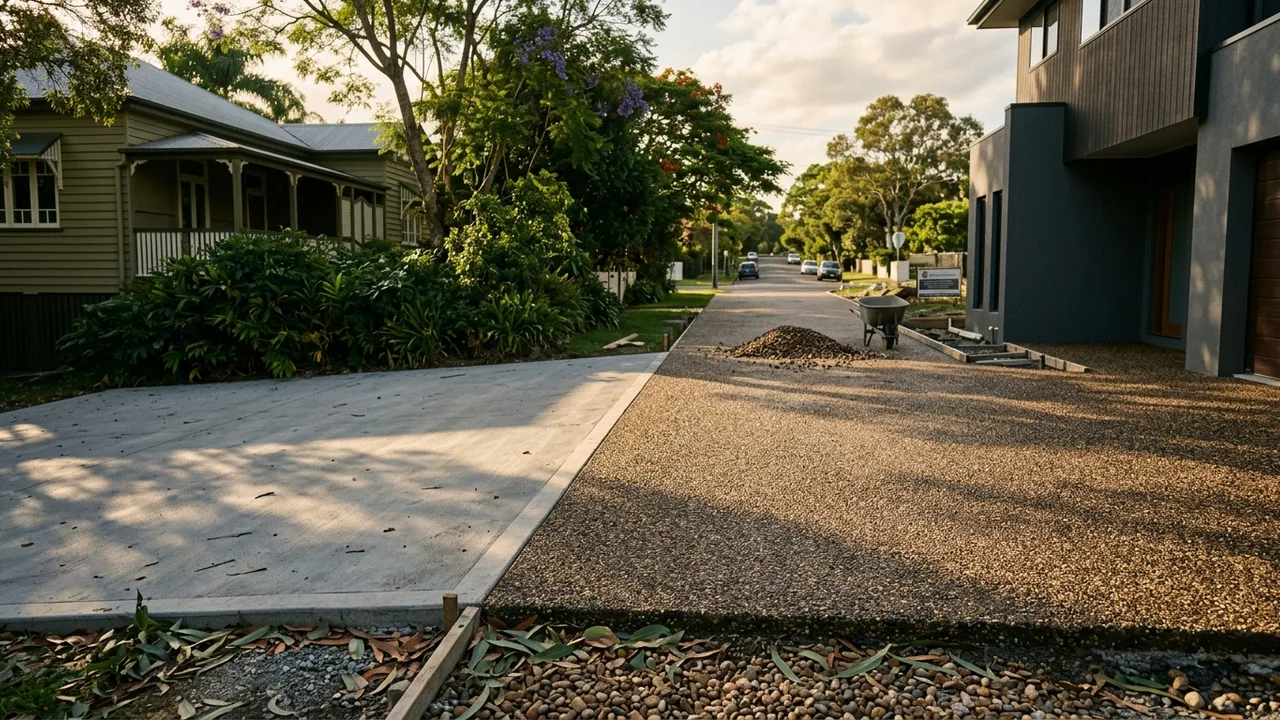
Plain concrete, however, shows cracking and surface wear more visibly. A single crack running through a smooth broom-finished surface is obvious. The same crack in a pebbly exposed aggregate surface is much less noticeable because the texture breaks up the visual line.
Staining also plays differently. Oil drips from cars show clearly on plain grey concrete. On aggregate, the same drip disperses across the pebble texture and is harder to spot, though it is still there and still worth cleaning.
On the maintenance side, exposed aggregate benefits from a seal every five to ten years, typically a penetrating sealer applied after a pressure wash. This helps resist staining and slows surface wear. Plain concrete can also be sealed but often is not, and it copes reasonably well without it in a sheltered suburban setting.
If a section of plain concrete spalls or cracks badly, repair patches are harder to blend invisibly. Aggregate repairs blend far more easily because the pebble texture hides the join.
Kerb appeal and house style
This is genuinely subjective, but there are some useful guidelines for western suburbs homes.
Post-war Queenslanders and highset timber homes in Chelmer, Graceville, and Sherwood often suit exposed aggregate well. The warm, natural texture of river pebble complements timber cladding, chamferboard, and leafy garden settings. A smooth grey concrete slab can look slightly industrial against an older character home.
Newer rendered brick or modern infill homes in Moorooka, Fairfield, and parts of Yeronga sometimes suit plain concrete better, especially if the palette is already clean and minimal. A polished or broom-finished concrete driveway fits a contemporary aesthetic without competing with it.
That said, aggregate is available in a wide range of blends, from subtle grey-brown river pebble to warm ochre tones that work with almost any home style. It is worth looking at samples in person rather than relying on photos.
One practical note: if you have an existing concrete path or garage slab that you want the new driveway to connect with visually, matching finishes is easier (and cheaper) than mixing them.
Which one should you actually choose?
If your priority is low ongoing maintenance and you have a heavily shaded driveway with lots of leaf fall, plain broom-finished concrete is a solid, honest choice. It sweeps clean, it is cheaper upfront, and it performs reliably.
If your priority is durability through decades of Brisbane summers, better crack concealment, and a surface that holds its look as the driveway ages, exposed aggregate is worth the extra spend. It performs particularly well on driveways with moderate tree cover (not dense overhead canopy), and it suits the character of most older homes in this part of Brisbane.
Most concreters working in the Inner West would tell you that exposed aggregate is now the more popular choice for driveways, and the reason is not just aesthetics. Homeowners who have lived with both tend to prefer the aggregate long-term. That is not a universal rule, but it is a reasonable pattern.
If you are still undecided, ask any concreters you get quotes from to show you examples of both finishes on local driveways. A reputable operator will be able to point you to completed work nearby. That is worth more than any photo on a website.
Quick answers