Concreting guide
Do you need council approval for concreting work in Brisbane?
Do You Need Council Approval for Concreting Work in Brisbane?
For most straightforward concreting jobs, no, you do not need council approval. A standard concrete driveway, backyard path, or patio slab typically falls under exempt development in Brisbane. But there are real exceptions, and getting it wrong can mean orders to remove work at your own cost.
Here is a plain-language breakdown of how the rules work, what triggers an approval requirement, and what questions to ask before your concreters start pouring.
What "Exempt Development" Actually Means
Brisbane City Council uses the term "accepted development" (or exempt development in older language) to describe building work that does not need a development application (DA) or building approval, provided it meets certain standards.
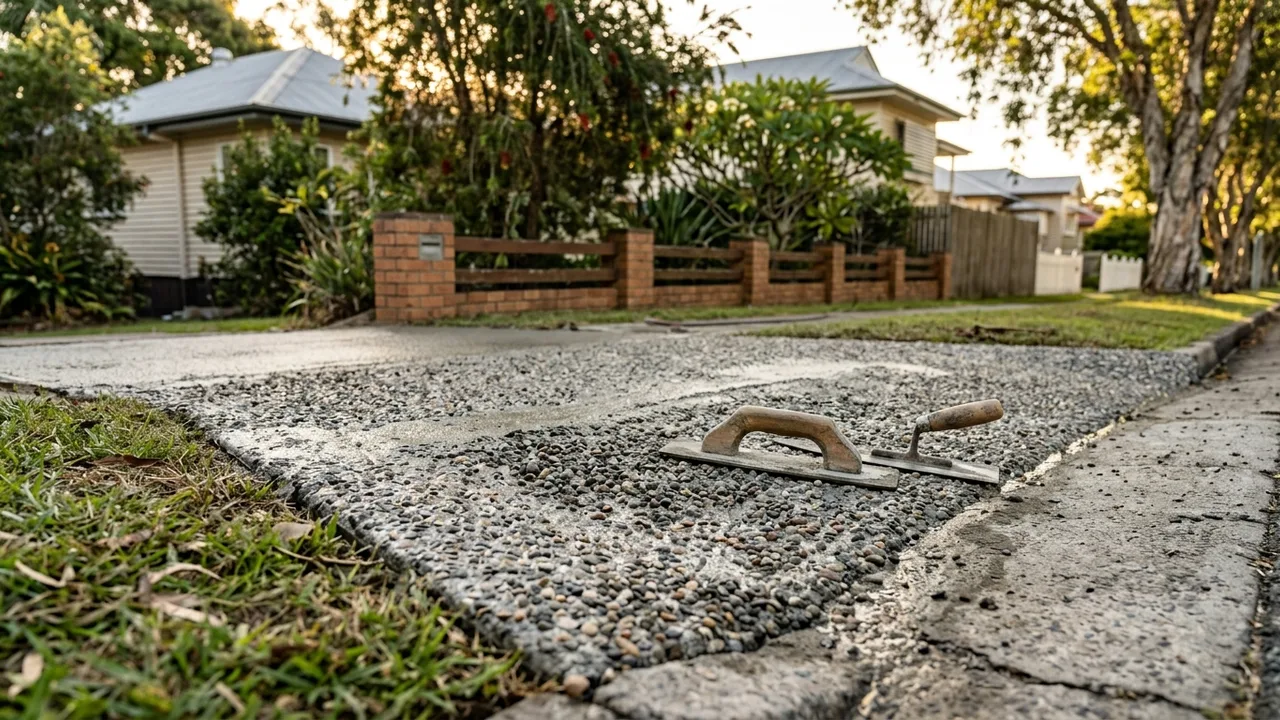
For concreting, the key document is the Brisbane City Plan 2014, specifically the overlay codes and the building work definitions. As a rule of thumb, if your concreting work is:
- At or near ground level (typically not elevated more than 1 metre above natural ground),
- Not part of a structure that requires building certification (like a load-bearing slab for a habitable room),
- Within setback requirements for your zone, and
- Not on a heritage-listed property or in a heritage overlay area,
...then it will usually fall within accepted development and need no formal approval.
That said, "accepted development" does not mean "do whatever you like." It means the work is pre-approved, provided it complies with the relevant code standards. The responsibility to comply sits with the property owner, not the council.
The Cases Where Approval Is Required
This is where it gets specific, and it matters for suburbs like Chelmer, Graceville, and Sherwood, where block sizes, slopes, and proximity to Kedron Brook tributaries and other waterways introduce extra constraints.
Stormwater and impervious surfaces. Brisbane City Council has rules about the proportion of your block that can be covered by impervious surfaces (concrete, pavers, roofing, etc.). If your new driveway or slab would push your total impervious area above council thresholds, you may trigger a stormwater management requirement. On larger residential lots this is rarely an issue, but on smaller inner-west blocks in Taringa or St Lucia, it can be.
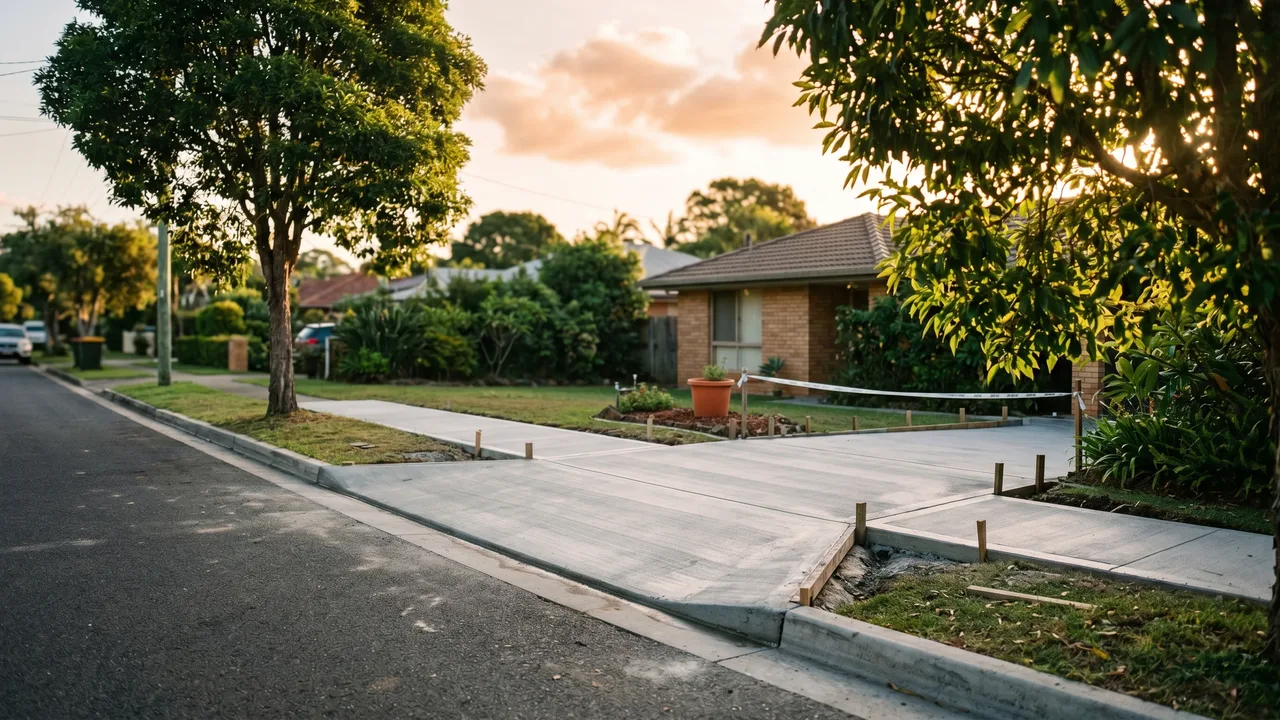
Driveways crossing the kerb. A new or relocated vehicle crossover, the section of driveway from your property boundary to the road, requires a separate application to Brisbane City Council's Infrastructure team, not a DA, but a specific crossover permit. This applies whether the driveway itself is concrete, asphalt, or gravel. The crossover is council's asset until it meets your boundary. Replacing an existing crossover in the same location is usually straightforward; moving it or adding a new one involves a separate approval process and a fee, typically in the low hundreds of dollars.
Heritage overlays. This is the one that catches people off guard. Parts of Chelmer, Graceville, Sherwood, and Corinda include properties on the Traditional Building Character overlay or formal heritage listings. If your home is in one of these categories, even landscaping and external hardscaping can require approval, particularly if it changes the visible character of the frontage. Check your property's overlay status via Brisbane City Council's Development.i.Q online mapping tool before you commit.
Retaining walls tied to slabs. If your concreting job requires a retaining wall over 1 metre high (measured from the bottom of the footing to the top of the wall), that wall itself requires building certification and, in some cases, engineered drawings. The slab adjacent to it may be fine, but the wall is not.
Shed and garage slabs. A slab on its own is typically exempt. But the shed or garage that sits on it usually requires a building approval. That approval process will reference the slab specifications, so it is worth having these done together and documented properly.
The Stormwater Question Deserves Its Own Section
Brisbane gets heavy summer rain, and the Inner West sees its share of localised flooding. Council takes stormwater management seriously, partly because poorly draining hardscaped yards push water onto neighbouring properties and into the drainage network faster than permeable ground would.
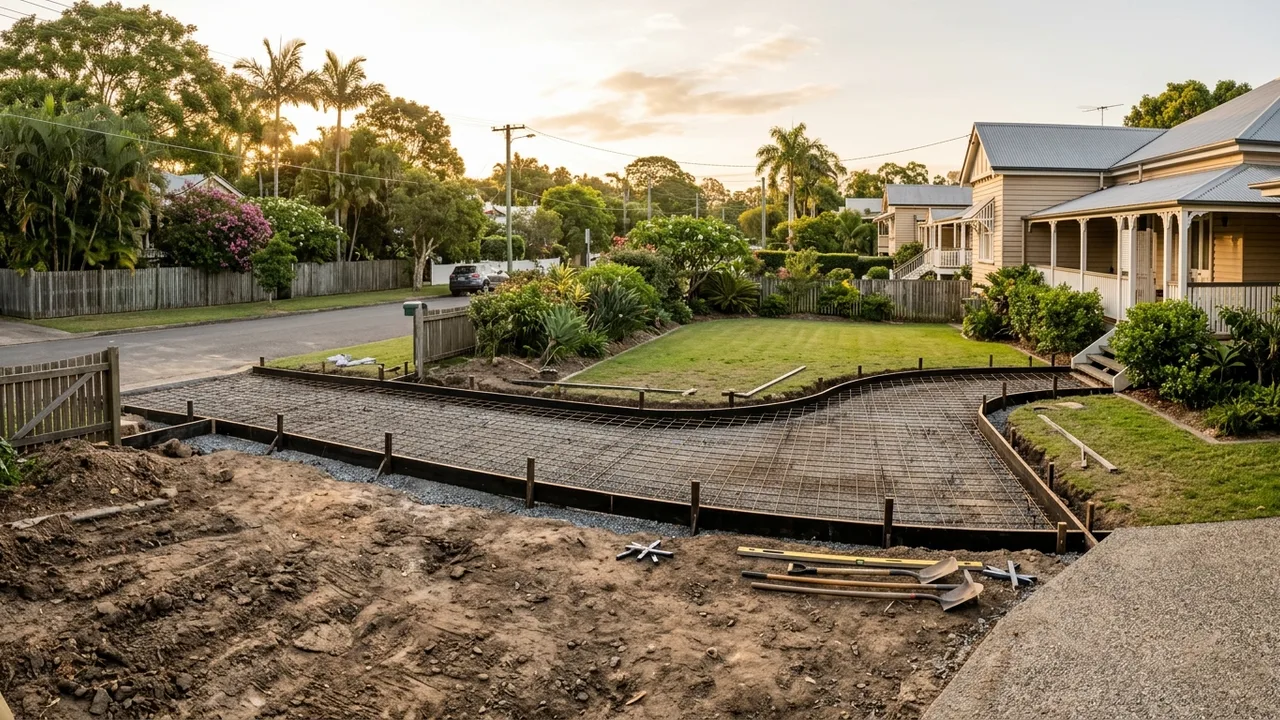
If you are laying a large concrete entertaining slab or replacing a gravel driveway with concrete, you should consider where the water goes. A compliant installation will direct runoff to either:
- An approved drainage point connecting to the stormwater system, or
- A legal point of discharge at the kerb (with appropriate drainage infrastructure).
A good concreter will factor this into the design. A cheap one might not. The cost of adding a basic drainage channel and connection point is modest compared to the cost of a council compliance notice or a flooded neighbour relationship.
DIY Versus Licensed Concreters: What the Rules Say
Concreting itself is not a licensed trade in Queensland the way electrical or plumbing work is. In theory, a capable homeowner can pour their own slab. In practice, the trade-offs are significant.
Concrete work is unforgiving. Once the pour starts, you have a narrow window. Mix proportions, reinforcement placement, expansion joint positioning, and finishing technique all affect how the slab performs over 10 or 20 years. A cracked, uneven, or spalling driveway costs more to fix than the original job.
The crossover permit is council's to inspect. Even if you do the rest of the driveway yourself, the crossover section that crosses council land will typically require inspection. Council wants to see it done properly.
For any work tied to a building approval (a garage slab, for example), the slab specs need to satisfy a building certifier. That process is much smoother when a licensed, insured professional has done the work and can provide documentation.
If your job is a small garden path in your own backyard? DIY is reasonable. If it involves a vehicle crossover, a garage slab, or a large entertaining area with drainage implications, using a professional is the lower-risk option both financially and from a compliance standpoint.
Practical Steps Before You Start
Look up your property on Development.i.Q. Brisbane City Council's mapping tool shows overlays, flood levels, and zoning. It is free and takes five minutes. Search "Brisbane Development.i.Q" to find it.
Check your impervious surface coverage. Measure what you already have (roofing, existing concrete, paving). If your new slab pushes things close to the limit, ask your concreters about drainage solutions.
Confirm the crossover situation. If the driveway meets the road, you will need a crossover permit. Your concreters should know this process; if they look blank when you mention it, that is worth noting.
Ask council directly if you are unsure. Brisbane City Council's planning and development team offers pre-lodgement advice. A quick call or online enquiry can confirm whether your specific job needs anything further.
Get documentation from your contractor. Even for exempt work, having the mix design, reinforcement specs, and drainage approach documented is useful when you sell the property or make an insurance claim.
A Closing Thought
Most standard concreting work in Brisbane's western suburbs proceeds without any council approval process at all. The exemptions are genuine and practical. But the exceptions, stormwater, crossovers, heritage overlays, retaining walls, are specific enough that "usually fine" is not the same as "always fine."
The sensible approach is to spend 20 minutes on the council's mapping tool, have a direct conversation with your concreters about drainage and crossover requirements, and ask council if anything looks uncertain. That costs nothing and protects you from a future compliance problem that could cost a great deal.
If you are looking for a local concreter in Chelmer, Graceville, Sherwood, or nearby suburbs who is familiar with Brisbane's requirements, that is exactly what this service helps with. There is no obligation in making an enquiry.
Quick answers