Concreting guide
What actually drives the cost of a concrete slab in Brisbane's western suburbs?
What Actually Drives the Cost of a Concrete Slab in Brisbane's Western Suburbs?
The price of a concrete slab is driven by four things: the volume of concrete required, the condition of the ground underneath it, the finish you choose, and how easy it is to get a truck and pump into your property. Everything else is a variation on those four. Understanding each one helps you read a quote intelligently, ask the right questions, and avoid being surprised when a $4,000 estimate becomes a $6,500 invoice.
Size Is the Starting Point, but It's Not the Whole Story
Volume is the most obvious cost driver. Concrete is priced per cubic metre, and the slab thickness adds up faster than most people expect. A standard 100 mm residential slab for a pathway uses roughly a third of the concrete that a 150 mm reinforced garage slab needs. That difference matters when you're comparing quotes.
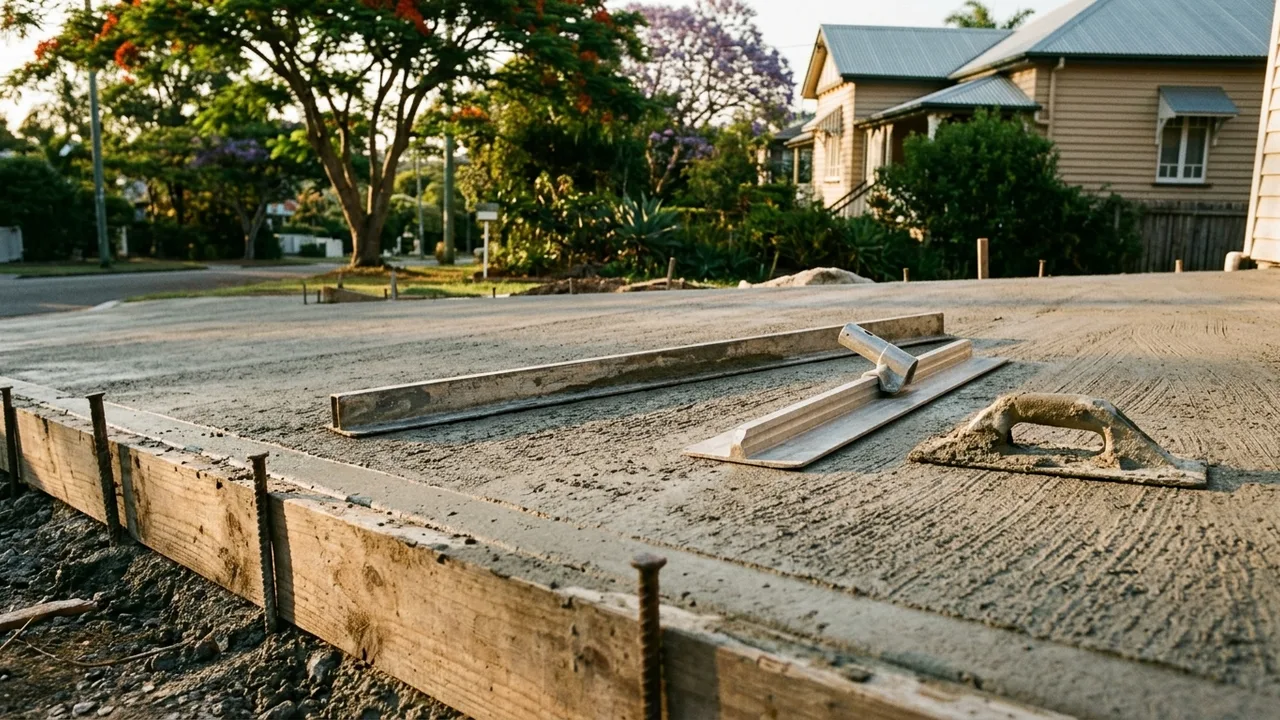
For a rough reference, a typical outdoor entertaining slab in the western suburbs (say, 6 m x 4 m at 100 mm thick) works out to around 2.4 cubic metres of concrete before waste. A double garage slab at 6 m x 6 m and 150 mm thick is closer to 5.4 cubic metres. At current Brisbane ready-mix prices, that difference in raw material alone can be $500 to $900. Labour scales with area too, so the gap widens.
Don't just measure the area. Ask your concreter what thickness they're recommending and why. A slab poured too thin to suit its purpose will crack earlier, and you'll be looking at resurfacing or repair within a few years rather than decades.
Ground Conditions in the Inner West Are Genuinely Variable
This is where Brisbane's western suburbs throw their main curveball. Chelmer, Graceville, Corinda and Sherwood sit on the Brisbane River floodplain, which means the soil is often reactive clay. Reactive clay moves with moisture changes. A slab poured directly onto unprepared clay is likely to crack.
The standard response is compacted road base or crusher dust as a sub-base layer, sometimes 75 to 100 mm deep. That adds material cost, a delivery, and compaction time. In some cases, particularly on sloping blocks in Taringa, St Lucia, or Indooroopilly, you'll need significant cut-and-fill work before a slab can even be formed up. That earthworks cost can easily add $800 to $2,500 to a job before a drop of concrete is poured.
If you're in a flood-affected zone (large parts of Chelmer and Corinda were inundated in 2011 and again in 2022), the soil may have shifted or been disturbed enough to require additional compaction or even a geotextile membrane underneath. Worth asking about directly rather than assuming the base preparation is included in a lump-sum quote.
Older properties in the cluster, particularly the Queenslander-era homes common in Graceville, Sherwood and Fairfield, sometimes have buried rubble, old stumps, or previous slab remnants that only show up during excavation. These are genuinely hard to price upfront, and an honest concreter will note them as potential variations rather than guarantee a fixed price before they've seen the ground.
Reinforcement: Mesh, Bar, or Neither?
Most residential slabs in Brisbane use steel reinforcing mesh (SL72 or SL82 are typical grades). For a driveway, this is standard and the cost is usually baked into the quote. For a shed or garage slab, you may need a heavier reinforcement schedule, particularly if vehicles or machinery will be on it.
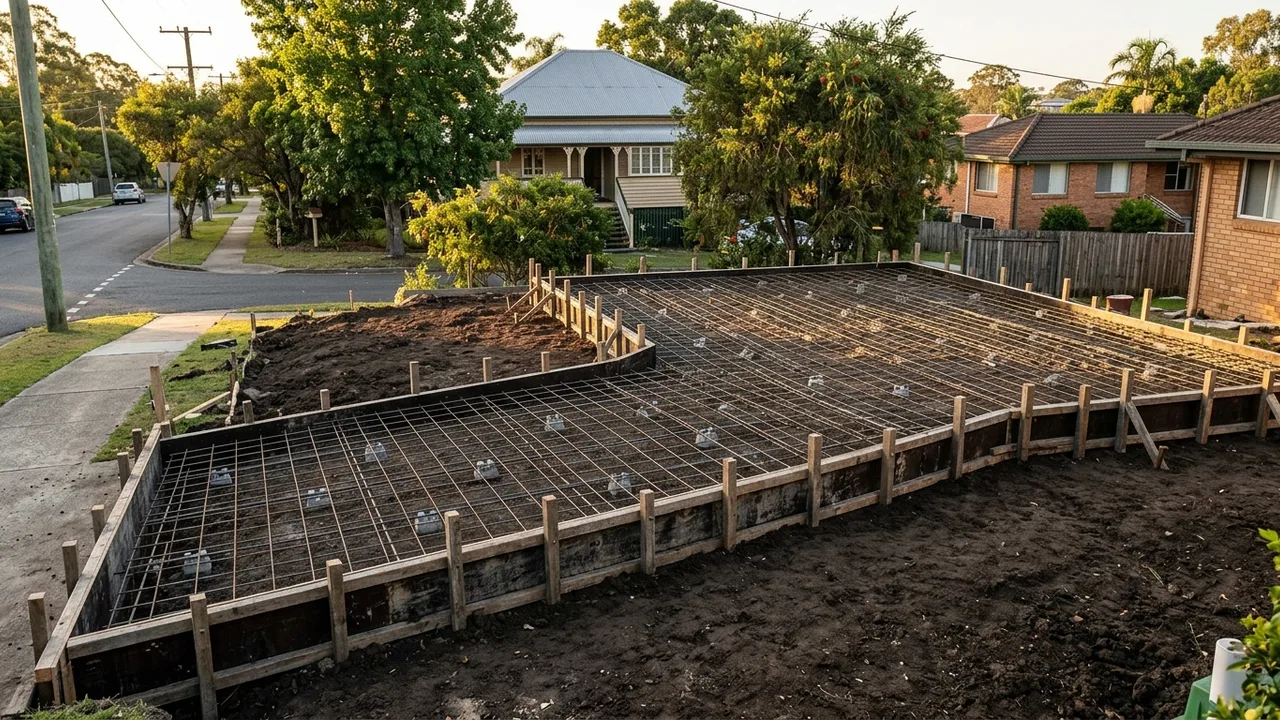
Steel prices have been volatile in recent years, which affects slab pricing more than most homeowners realise. A 6 m x 6 m garage slab might use 8 to 10 sheets of mesh, and when steel prices spike, that alone can shift a quote by $200 to $400.
Some concreters offer polypropylene fibre additives as a partial alternative to mesh for lightly loaded slabs. Fibre-reinforced concrete handles shrinkage cracking well but is not a direct substitute for structural steel mesh in a load-bearing application. Be sceptical if someone suggests dropping mesh entirely from a driveway or garage slab to save money.
Access and Pump Hire: the Hidden Cost Variable
This is the factor most homeowners don't think about until they see an itemised quote. In the western suburbs, a lot of properties have narrow side gates, mature trees close to the boundary, and sloping sites. All of these affect whether a ready-mix truck can reach the pour location directly.
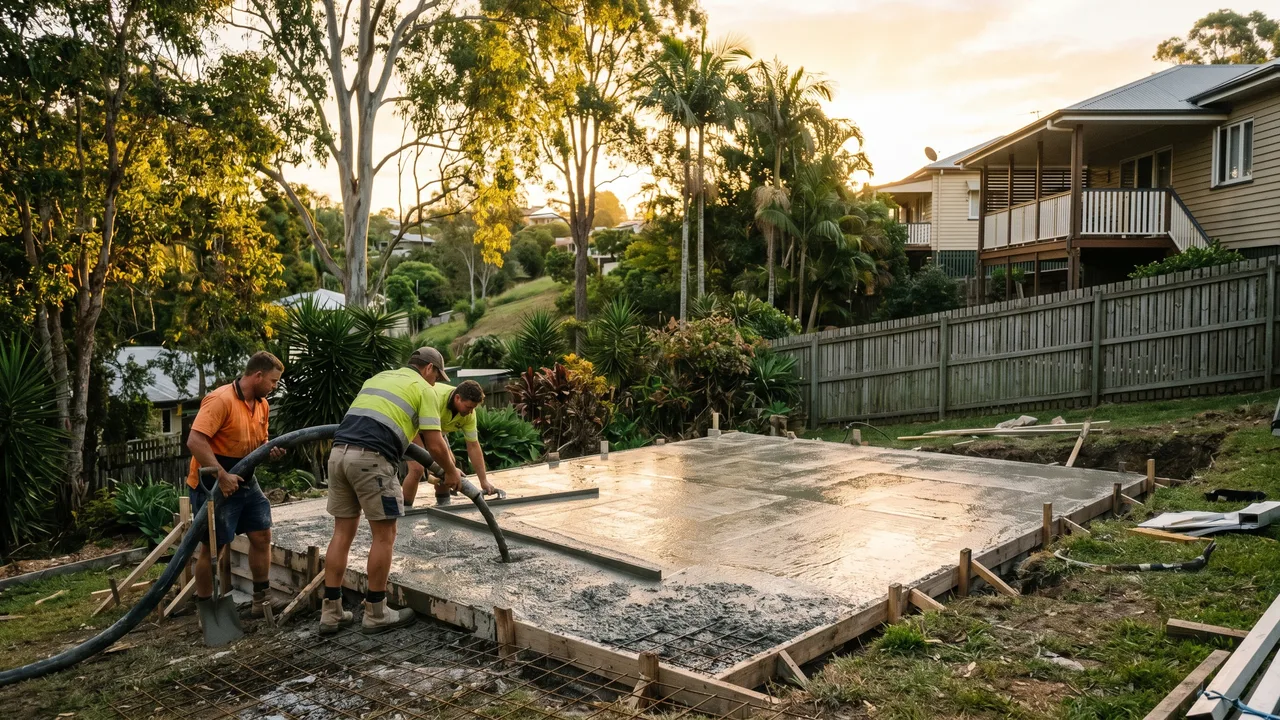
When the truck can't reach, you need a concrete pump. Pump hire typically adds $400 to $900 to a job depending on the pump size and how long it's on site. It's not a rip-off; it's just the cost of getting concrete to an inaccessible backyard entertaining area or a rear-of-block garage slab.
Some streets in Taringa and St Lucia have restricted parking and kerb access, which can limit truck manoeuvrability and require a smaller agitator truck (which carries less per load, meaning more loads and higher delivery fees). If your property has a long, narrow driveway, overhanging trees, or a back pad more than about 15 metres from street access, mention it clearly when getting quotes. It changes the job significantly.
Finish Choice and What It Actually Costs
A plain broom finish is the base price. It's functional, slip-resistant, and does the job for most driveways and pathways. From there, the options add cost at different rates.
Exposed aggregate is the most popular decorative choice in the western suburbs right now. The process involves seeding the surface with decorative aggregate (typically river pebbles or crushed granite), then washing back the cement surface to expose the stone. For a comparable area, exposed aggregate typically adds 20 to 40 per cent over a plain concrete finish. That premium is partly materials, partly the labour involved in timing the wash-back correctly. On a 40 m² driveway, the difference might be $600 to $1,200.
Coloured concrete (via oxide pigments) adds a modest premium, usually $5 to $15 per square metre depending on colour depth and supplier. Stencilled or patterned concrete involves more form work and labour time, and is generally more expensive than exposed aggregate.
Worth knowing: decorative finishes can be harder to repair invisibly if the slab ever needs patching. For high-traffic driveways, a quality plain finish or conservative exposed aggregate is often the more sensible long-term choice over elaborate patterns.
Getting a Quote That Actually Reflects Your Job
The range for residential concrete work across the Chelmer cluster runs roughly from $1,500 for a small pathway to $15,000 or more for a full driveway replacement with exposed aggregate finish and significant sub-base preparation. That's a wide range because the jobs are genuinely different.
A useful quote should specify: slab dimensions and thickness, sub-base preparation (type and depth), reinforcement specification, finish type, whether pump hire is included or conditional, and any exclusions around unforeseen ground conditions.
If a quote doesn't mention sub-base or reinforcement, ask. A lower price that skips proper preparation isn't a saving; it's a cost you'll pay later through cracking and repair work.
Three quotes is sensible for any job over $3,000. One quote gives you a number; three gives you a comparison. If one quote is noticeably lower, ask what's different rather than assuming it's the best deal.
A good concreter who knows the inner west will ask about your site before quoting, not after. If someone gives you a firm price over the phone based only on dimensions, treat it as an estimate at best.
When you're ready to get specific quotes for your property, it helps to have your site measurements, a rough idea of finish preference, and any known access constraints ready to share. That gives a concreter enough to work with for a realistic number, rather than a ballpark that shifts once they see the job.
Quick answers