Concreting guide
Concreting on a sloped block: what western suburbs homeowners need to know
Concreting on a Sloped Block: What Western Suburbs Homeowners Need to Know
Sloped blocks are not a barrier to good concreting work, but they do change almost everything about how a job is planned, priced, and built. If your block in Chelmer, Indooroopilly, Taringa, or anywhere else in Brisbane's inner west sits on a gradient, expect the project to take more time, more material, and more careful engineering than a flat-site equivalent. That is not a reason to avoid it. It is just what you need to budget and plan for honestly.
Why the Inner West Has More Sloped Blocks Than You Might Expect
The western suburbs of Brisbane sit within the catchment of the Brisbane River, and the land rolls accordingly. Chelmer, Graceville, and Sherwood back onto the river floodplain on their lower edges, while Indooroopilly, Taringa, and St Lucia rise toward the ranges. Yeronga, Fairfield, and Moorooka carry a similar pattern of rises and gullies.
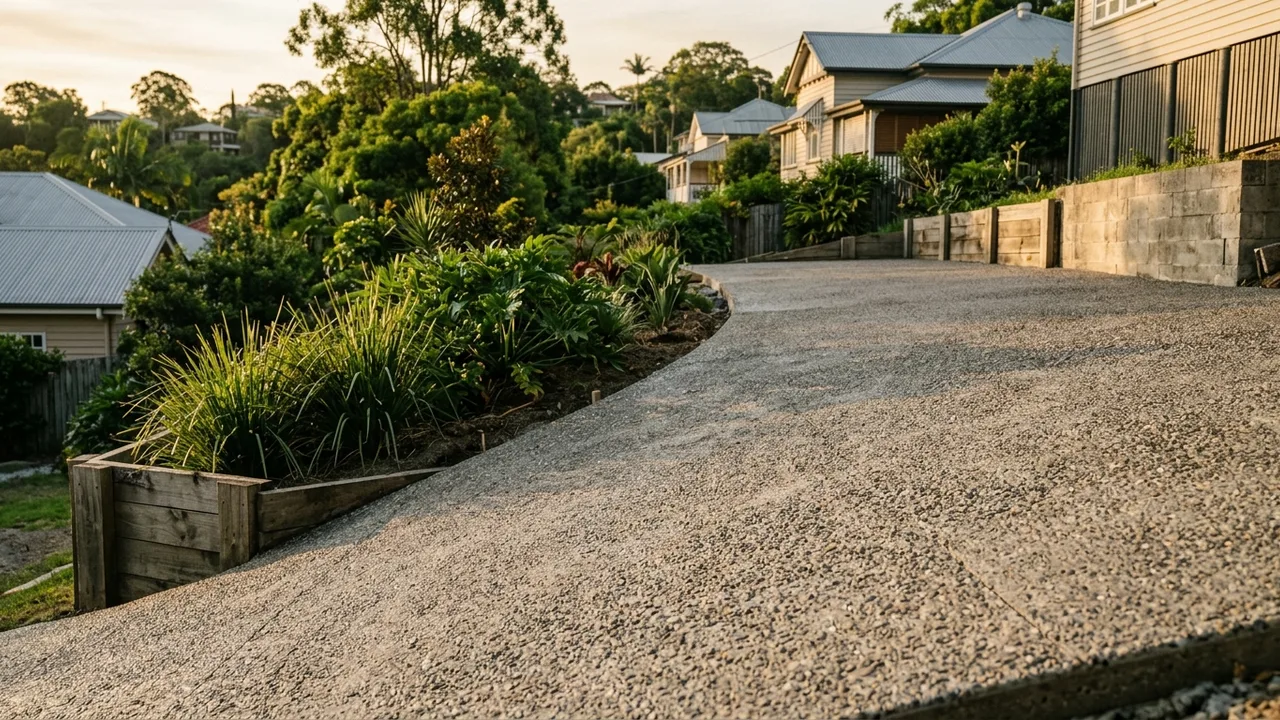
Add to that the prevalence of Queenslander and post-war homes built on stumps specifically to deal with sloped sites, and you get a suburb cluster where off-camber driveways, split-level backyards, and terraced gardens are the norm rather than the exception. Many of these blocks have never had a proper concrete path or slab installed because previous owners put it in the "too hard" basket.
It is not too hard. But it does require a concretor who has actually worked on sloped residential sites, not just poured slabs in a flat industrial yard.
The Core Problem: Water Goes Where Concrete Sends It
On a flat block, water runoff is fairly predictable. On a slope, every decision you make about slab level, edge height, and surface fall determines where water ends up after rain. Get that wrong, and you can direct water toward a neighbour's fence, under your house, or into a garden bed that cannot absorb it.
Brisbane's inner west gets a solid share of summer storm rainfall. During a downpour, a driveway on a gradient can act like a channel if it is not designed to shed water to a specific point (typically a kerb, a drain, or a vegetated edge). Before any concrete is poured, the drainage plan needs to be settled. That means:
- Identifying where the natural fall runs on your block.
- Deciding whether you need a channel drain, a spoon drain, or just a well-graded edge.
- Checking whether your local Brisbane City Council requirements call for any specific drainage provision for your site.
In most cases, a concretor with local experience will flag this early. If one does not mention drainage at the quoting stage, that is worth querying directly.
How Slope Affects Cost and Complexity
Here is where honesty matters. A sloped site costs more to concrete than a flat one, and the steeper the slope, the bigger that cost difference becomes. The main reasons are:
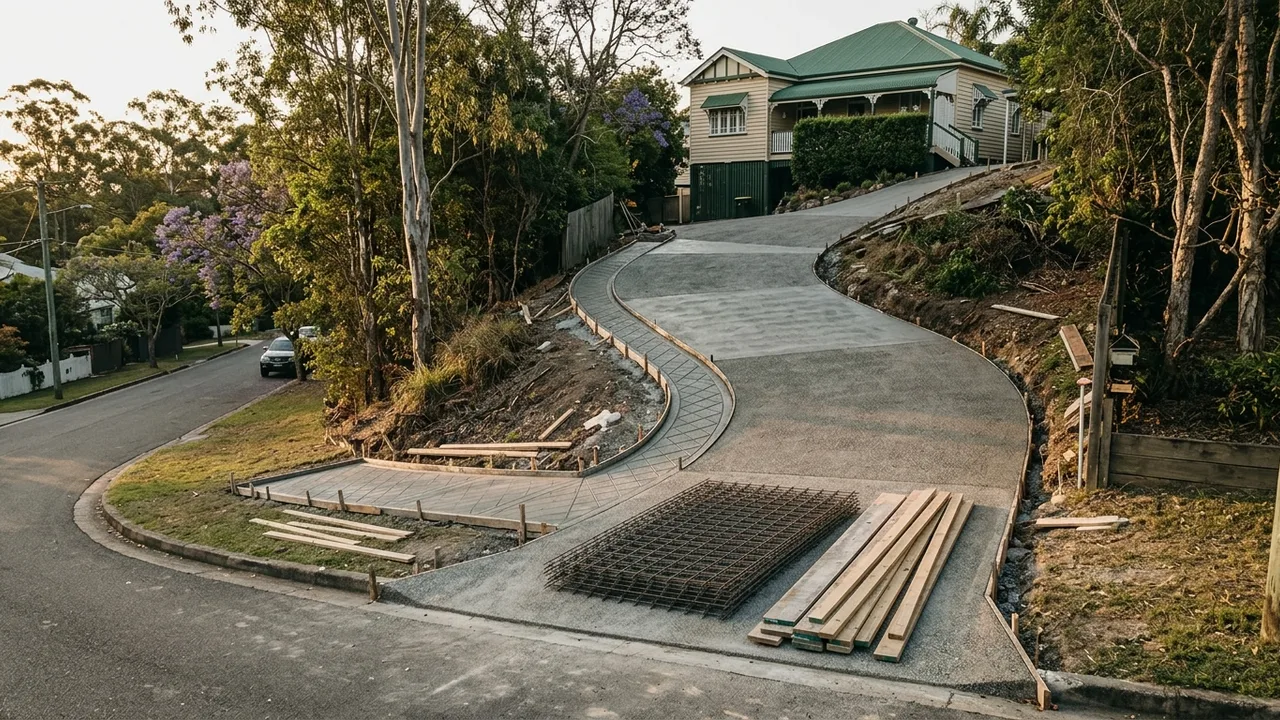
Formwork. On a flat site, formwork (the timber or steel edging that holds wet concrete in place) is straightforward. On a slope, it has to be built at varying heights and often stepped or ramped to follow the grade. That takes more time and material.
Excavation and fill. Depending on the gradient, you may need to cut into the slope on one side and build up on the other to create a level or gently graded surface. If fill is required, it needs to be compacted properly, not just shovelled in. Poorly compacted fill under a slab is one of the more common causes of cracking within a few years of pour.
Reinforcement. A slab that is elevated on one edge, even slightly, carries more load stress than a fully supported flat slab. Mesh reinforcement (typically SL72 or SL82 mesh in residential work) is standard, but steeper or larger slabs may warrant steel bar (rebar) reinforcement instead. A good concretor will advise on this based on your specific site.
Concrete volume. When you step or ramp a slab to follow a slope, you often use more concrete than a simple flat calculation would suggest. Getting accurate volume estimates early helps avoid budget surprises.
As a rough guide, a standard flat driveway in the western suburbs might sit somewhere in the $3,000 to $7,000 range for a typical double-width pour. A sloped or stepped equivalent on a comparable site could run 20 to 40 per cent higher, depending on how much earthwork is involved. These are indicative figures only; your site will determine your actual quote.
Stepped vs Ramped Slabs: Which Suits Your Site?
For outdoor areas and paths, you have two broad approaches on a sloped block: step the slab down in flat sections, or ramp it continuously.
Stepped slabs suit entertaining areas, poolside pads, and garden paths where you want level surfaces to put furniture, pot plants, or outdoor kitchens. They create defined zones. The trade-off is that you need to manage the step heights carefully for safety, and steps can be a trip hazard if poorly lit or if there are many of them over a short run.
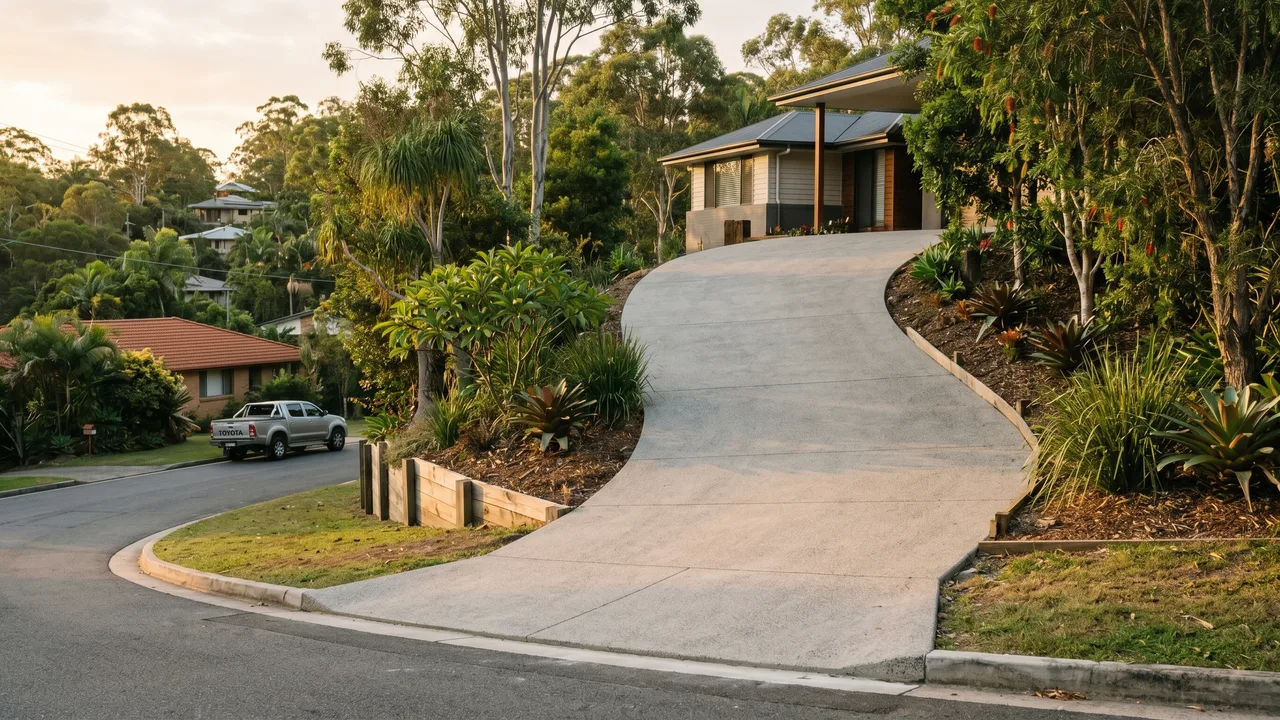
Ramped slabs suit driveways and access paths where continuous vehicle or foot traffic needs to flow without interruption. A driveway cannot reasonably be stepped. The grade needs to work for both drainage and vehicle clearance. Most passenger vehicles cope reasonably well with grades up to about 1 in 5 (20 per cent), though steeper than that and you start getting scraping issues with low-clearance cars.
For driveways in particular, check whether your council requires a concrete or bitumen crossover from the kerb, and whether the transition from the street grade to your private driveway grade needs a specific treatment. Brisbane City Council has guidelines on this, and your concretor should be across them for your area.
Exposed Aggregate and Finish Choices on a Slope
Finish choice matters more on a sloped site than a flat one. A smooth broom finish, which is standard and cost-effective, gives adequate grip for most residential slopes. But if your driveway is steep, or if your path runs through a shaded area that stays damp (common in inner west gardens with large fig or mango trees close to the house), a more textured finish is worth the modest extra cost.
Exposed aggregate finish is a practical choice for sloped driveways and paths in the western suburbs. The texture of the exposed stone provides more grip underfoot and under tyre than a brushed surface, and it also holds up well visually on a gradient where a plain slab can look a little bleak. It costs more to install, typically adding $30 to $60 per square metre over a standard broom finish, but it ages well and does not need sealing to look presentable.
Avoid a very smooth or polished finish on any surface that sees slope and rainfall together. It can become slippery when wet, which creates a genuine safety issue.
Getting Quotes Right the First Time
On a sloped block, accurate quoting requires a site visit. Any quote given over the phone or based solely on measurements without a physical inspection should be treated as preliminary only. The things a concretor needs to see in person include:
- The actual gradient and how it changes across the site.
- Existing drainage and where water currently flows.
- Soil type and stability (some inner west sites have clay-heavy soil that moves seasonally).
- Access for a concrete truck or pump truck, which on a steep or narrow block may not be straightforward.
- Proximity to trees, particularly large established trees with roots that could affect slab longevity.
Get at least two or three quotes. Ask each concretor to explain their drainage plan and what happens to water at the bottom of your slope once the slab is in. That question alone will tell you a lot about their experience with sites like yours.
A Closing Word
Sloped blocks in the inner west are not a concreting problem waiting to happen. They are a design challenge that good preparation resolves. The homeowners who regret their slab pours are usually the ones who focused only on price per square metre and skipped the drainage conversation. The ones who are satisfied are the ones who understood the site first and let that drive the design.
If you are weighing up options or trying to get a realistic sense of scope before approaching a concretor, getting a local referral to someone who has worked on similar blocks in Chelmer, Sherwood, or Indooroopilly is a reasonable starting point. Not every concretor quotes sloped residential work regularly, and experience with your specific terrain type makes a genuine difference.
Quick answers