Concreting guide
Why does residential concrete crack and can it be prevented?
Why Concrete Cracks — and What You Can Actually Do About It
Concrete cracks. Almost all of it does, eventually. The question worth asking isn't whether your driveway or slab will crack, but why it happens and whether those cracks are a cosmetic nuisance or a structural problem worth fixing. The short answer: most residential cracking is preventable with decent planning, proper mix design, and good installation practice.
The Basic Reason: Concrete Moves, But It Can't Stretch
Concrete is strong in compression. Push down on it and it holds. Pull it apart or bend it and it fails relatively easily. That's the fundamental tension (no pun intended) in every slab poured on a residential block.
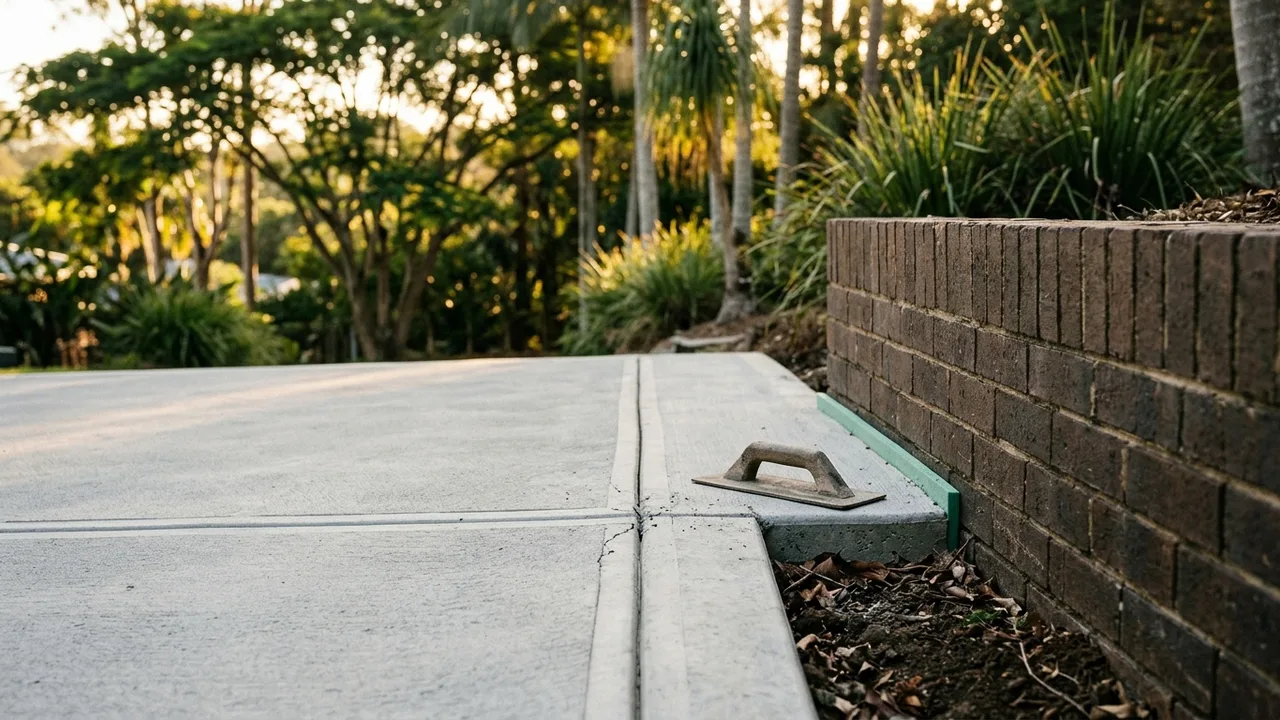
As concrete cures, it shrinks. Water evaporates, the cement paste contracts, and the slab wants to get smaller. The ground underneath resists that movement. So the slab fights itself, and where the stress concentrates, a crack forms.
Beyond the initial cure, concrete keeps responding to its environment. In Brisbane's subtropical climate, surface temperatures can swing dramatically between a cool July morning and a January afternoon that hits the mid-30s. That thermal expansion and contraction is a slow, ongoing stress cycle. Over years, it adds up.
So no, you can't make concrete completely crack-proof. But you can make it crack on your terms, in places that don't matter, rather than randomly across the middle of your driveway.
Brisbane's Soil Is a Big Part of the Story
If you live in Chelmer, Graceville, Sherwood, or anywhere in the Bremer River corridor, there's a reasonable chance your block sits on expansive clay soil. Brisbane's inner west has a lot of it. This type of soil absorbs moisture and swells, then dries out and shrinks. It does this repeatedly across the seasons.
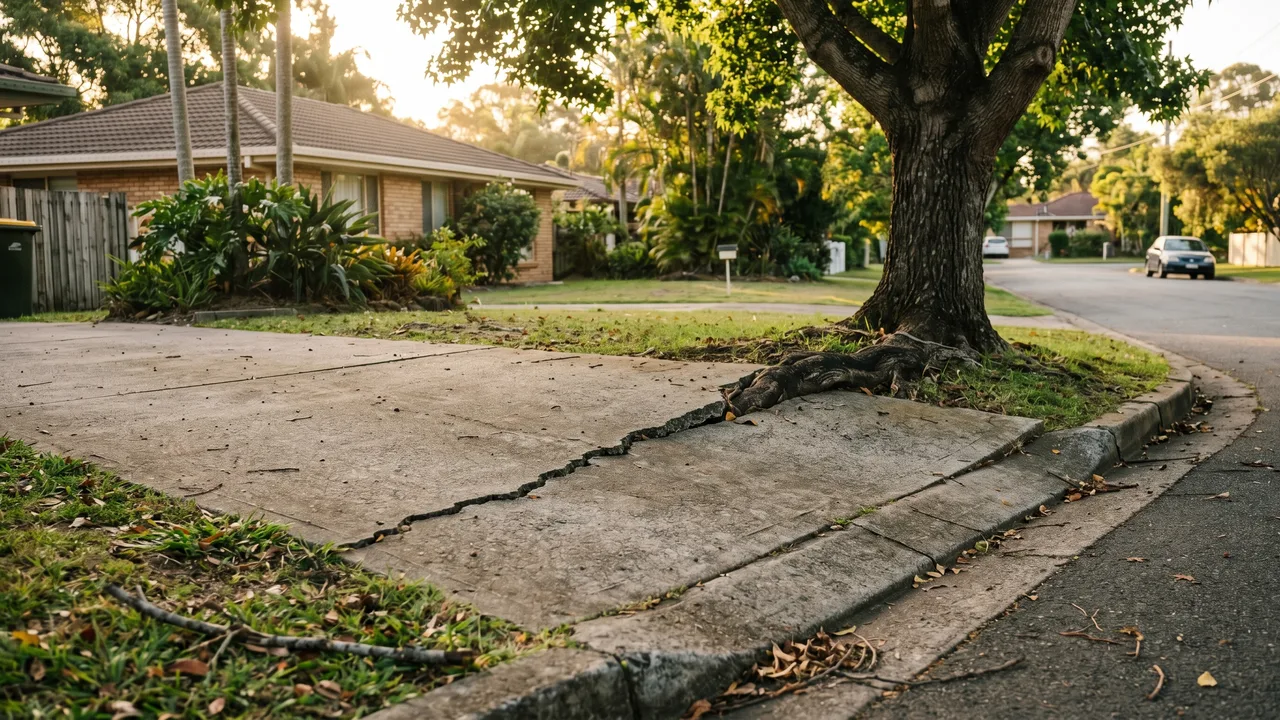
A concrete slab sitting on reactive clay is working hard just to stay level. When the soil heaves, the slab lifts. When it dries and drops, the slab loses support underneath. Over time, that cyclic movement creates the classic "corner lift" on driveways, or long diagonal cracks running from slab corners.
This is also why a driveway poured on a sunny slope in St Lucia or Taringa might outlast a similar slab in Corinda by a decade. The specific subgrade conditions under your property matter enormously, and anyone quoting a concrete job without checking them is cutting corners.
The fix isn't to panic about your soil type. It's to prepare the sub-base properly: typically 100mm of compacted road base material, sometimes more on problematic ground, plus steel reinforcement or fibre reinforcement in the concrete mix itself.
The Four Most Common Causes of Residential Cracking
Understanding what actually drives cracking helps you ask better questions when you're dealing with a contractor or assessing damage.
Shrinkage cracking is the most common type. It appears within the first few weeks of a pour, often as a faint network of fine lines (called "crazing" or "map cracking") or as longer cracks running across the slab. It's largely controlled by two things: the water-to-cement ratio in the mix, and the presence of control joints.
Control joint failure is related. Control joints are the lines you see cut or tooled into a concrete driveway or path. They're deliberately weak planes that encourage the slab to crack along a straight, hidden line rather than wherever it likes. If joints are spaced too far apart (as a rule of thumb, spacing in metres shouldn't exceed 2.5 times the slab thickness in centimetres), the slab will crack somewhere between them instead.
Subgrade settlement happens when the ground under the slab isn't compacted properly, or when tree roots shift the soil. Inner west Brisbane properties with large Poinciana or fig trees nearby are at particular risk. A slab poured over loosely filled ground will always find the weak spots.
Overloading is less common in residential settings but worth knowing. A 100mm residential driveway slab is typically designed for passenger vehicles. Park a loaded concrete truck, a skip bin, or a heavy excavator on it regularly and you're asking for trouble.
What the Installation Process Can Do to Prevent It
The work done before the concrete is even poured determines most of the outcome. There are a handful of practices that separate a slab that lasts 30 years from one that's showing problems in five.
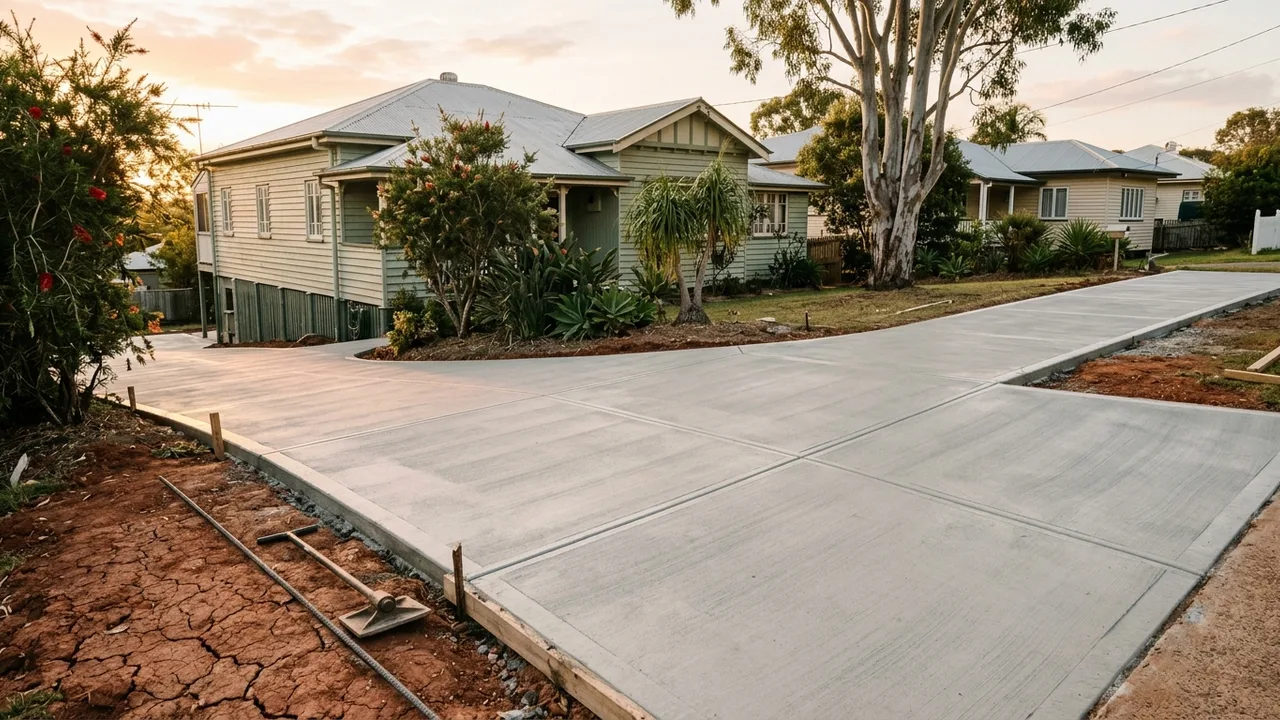
Sub-base preparation. The ground should be excavated, graded, and compacted before any pour. On reactive soils, a layer of road base that's properly compacted with a plate compactor makes a significant difference.
Correct mix design. Residential slabs typically use a 20 to 25 MPa mix. Higher strength isn't always better if it means a stiffer, less workable mix on site. The water-cement ratio matters more than the raw strength number.
Reinforcement. SL72 or SL82 steel mesh, or polypropylene fibres added to the mix, give the concrete tensile capacity it wouldn't otherwise have. Neither eliminates cracking, but they hold cracks tightly together and prevent them from widening or causing the slab to shift.
Control joints, placed early and correctly. These should be cut to a depth of roughly one-quarter of the slab thickness, and placed before the concrete gets too hard (typically within 24 hours for saw cuts, or formed during the pour for tooled joints).
Proper curing. Concrete needs moisture to cure correctly. In Brisbane's summer heat, a slab left to dry out too quickly in direct sun will surface-crack within hours. Covering with hessian and keeping it wet, or using a curing compound, slows moisture loss and gives the concrete time to reach its design strength.
When Cracks Appear: Cosmetic vs Structural
Not every crack needs action. Fine surface crazing less than 0.2mm wide is mostly cosmetic. It looks rough but doesn't compromise the slab. Wider cracks that go through the full depth, cracks with vertical displacement (one side higher than the other), or cracks that are actively growing are different matters.
Displacement across a crack tells you the two sections are moving independently. That usually means subgrade support has been lost under one section. Repair without fixing the underlying cause is short-lived.
For cosmetic cracks, concrete resurfacing or crack injection can give a driveway or path several more years of decent service at a fraction of replacement cost. For structural cracking, resurfacing is a cosmetic fix on top of a structural problem. It buys time but not a solution.
The honest trade-off: resurfacing typically costs a few hundred to around $1,500 for a driveway, depending on area and condition. Full replacement of a residential driveway in the Brisbane western suburbs generally runs $3,000 to $8,000 or more for a standard double-width pour. Patch now, replace later is sometimes the right call; other times you're paying twice.
What You Can Do as a Homeowner
You can't control the soil your house sits on, but you can manage a few things:
- Keep garden beds and irrigation away from slab edges. Saturating the soil on one side of a driveway repeatedly creates uneven moisture levels, which drives differential movement.
- Deal with tree roots early. A root running under a path or driveway will eventually lift it. Root barriers during installation are far cheaper than replacement later.
- Seal your concrete every few years. A penetrating sealer slows moisture absorption into the surface, reducing the thermal and moisture cycling that drives surface cracking.
- Don't ignore small cracks. Water gets in, the sub-base softens, freeze-thaw isn't a major factor in Brisbane, but sustained wet-dry cycling is. A small crack treated early stays small.
A Final Word on Getting It Right
The single most reliable way to avoid cracking problems is to have the slab done properly the first time. That means a contractor who prepares the subgrade, uses appropriate reinforcement, cuts control joints correctly, and cures the concrete rather than walking away as soon as the truck leaves.
None of that is exotic. It's standard practice among competent concreters. But it's worth asking about explicitly when you're comparing quotes, because shortcuts in preparation are invisible until they're not.
If you're seeing cracking on an existing slab and aren't sure whether it's cosmetic or something more serious, a local concreter who works in your suburb can give you a straight answer on-site. Most will assess it in a short visit.
Quick answers